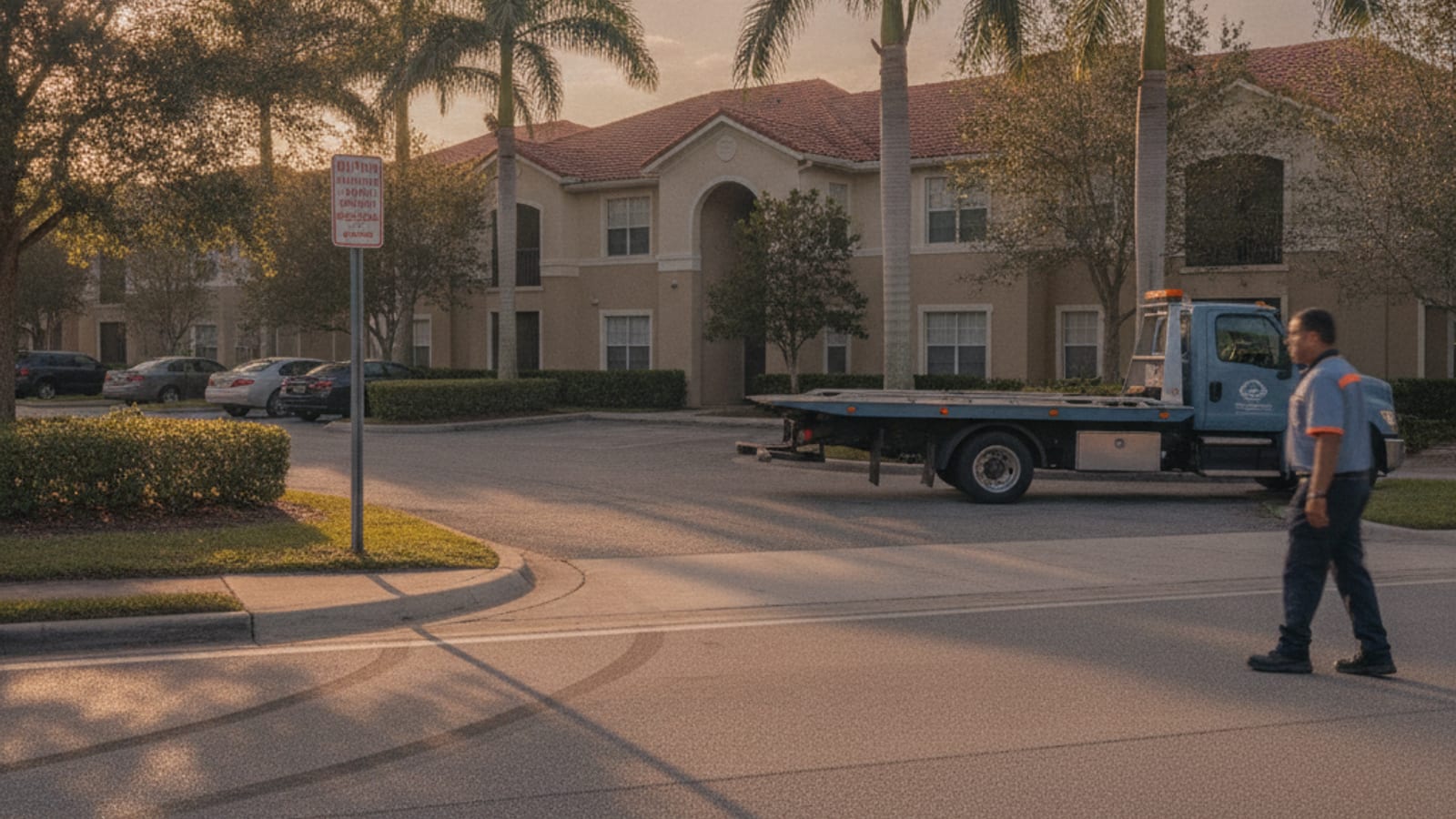
Florida Statute 715.07 spells out exactly what has to be on a tow-away sign before a property owner, landlord, or HOA can have a car towed without the driver’s consent. The sign has to sit at every driveway or curb cut within 10 feet of the road, carry specific wording in specific letter sizes, hang 3 to 6 feet off the ground, and stay up at least 24 hours before any tow happens. In Orange County, the ordinance layers on one more requirement: a QR code linking to the county’s own parking information page. Miss any piece of it, and the tow itself sits on shaky ground, whether you’re the one who posted the sign or the one whose car just disappeared.
What has to be on the sign itself
Florida law is specific about size, not just wording.
The words “Tow-Away Zone” have to appear in light-reflective letters at least 4 inches tall, set on a background color that contrasts with the letters so they read at a glance. Below that, a warning that the vehicle will be removed at the owner’s expense has to run at least 2 inches tall. The sign also needs the towing company’s name and a current phone number, not a leftover number for a vendor the property switched away from months ago. All of it has to be mounted between 3 and 6 feet off the ground, low enough to read from a car window and high enough that nothing blocks it.
Where every sign has to go, and how long before it counts
Placement matters as much as wording. State law requires a sign at each driveway or curb cut that sits within 10 feet of the road, not just one sign at the main entrance of a multi-entrance lot. A property with a front gate and a side alley cut needs a sign at both, not one.
Timing is just as strict. The sign has to be in place at least 24 hours before a car can legally be towed from that spot. Put a sign up this morning and tow someone the next afternoon, and you’re covered. Put it up and tow someone the same day, and you’re not.
The exception for small lots
Not every property needs the full four-part sign. A lot with 20 spaces or fewer can post a simplified notice instead, something shorter along the lines of “Reserved Parking for Customers Only,” rather than the complete Tow-Away Zone wording described above. It’s a narrower exception than a lot of property managers assume, and it only applies below that 20-space threshold.
What Orange County adds on top of state law
FS 715.07 sets the floor every Florida property has to meet, but Orange County’s Chapter 35 ordinance adds requirements of its own, and that’s the layer that actually governs inside the county.
The most visible addition is a QR code. Orange County requires every tow-away sign to carry one linking to the county’s parking information page at ocfl.net/parking, on top of everything the state statute already requires.
The bigger addition is money. FS 715.07 itself sets no dollar figures. Florida Statute 125.0103(1)(c) is what makes counties set maximum rates, and Orange County has done so. Florida Statute 166.043(1)(c) then lets a city displace the county schedule inside its own limits, and the City of Orlando has done that too, so which cap applies to a given tow depends on where the vehicle was picked up.
In unincorporated Orange County, Chapter 35 caps a trespass tow on a standard passenger vehicle up to 10,000 pounds at a flat $135, with storage at $32 a day. A city may enact its own schedule inside its limits under Florida Statute 166.043(1)(c). City of Orlando dollar caps are not restated here because they were not independently verified for this article. The county figures are legal maximums for the work Chapter 35 covers, not Quick Tow Orlando prices, and they do not apply to a private tow you call yourself.
What happens after the tow
Two more rules apply once the truck actually moves the car.
State law requires the tow operator to notify local police within 30 minutes of completing the tow. Orange County’s version of that rule is more specific: notify the Sheriff’s Office within 30 minutes of arriving at the storage yard with the vehicle.
If the driver shows up before the car is fully removed, meaning it’s already hooked up but the truck hasn’t left yet, state law caps what can be charged at half the posted rate. Orange County’s version of that same rule works out to $67.50 for a standard car, and the operator has to give the driver at least 15 minutes on scene to make that happen.
The one case that needs no sign at all
One situation skips the sign requirement entirely. If a car is parked on the public right-of-way in a way that blocks access to a private driveway, or that restricts normal business operations, Florida law lets the property owner, lessee, or their agent have it removed without posting a tow-away sign first. It’s a narrow carve-out, not a loophole for skipping signage in general, so it only applies when a car is genuinely obstructing a driveway or blocking a business from operating.
If your car is already gone
Everything above is written for the person posting the sign, but it works the other way too. If you’re the one who came back to an empty parking space, the requirements above are exactly what determines whether that tow was legal in the first place. Missing wording, an unreadable phone number, or a sign that went up the same morning instead of 24 hours ahead can all be grounds to question what happened. For the full walkthrough on tracking down your car and knowing your rights at the tow yard, see our guide on being towed from private property in Orlando. If you’ve already confirmed something about the tow looks wrong, how to dispute a tow in Orlando walks through the next step.
When to call us
Quick Tow Orlando is a referral line, not the storage yard and not law enforcement, and we don’t set Orange County’s rate caps. We connect property managers who need a lot cleared under a compliant sign, and drivers who need a car moved after a breakdown, with independent operators. The operator is responsible for the tow, capability, timing, price, and terms. If you manage a property and want to talk through signage before the next tow, or you need private property towing matched to a local operator, call (321) 321-9797.
Frequently asked questions
How big does the “Tow-Away Zone” text have to be on a sign?
At least 4 inches tall, in light-reflective letters set on a contrasting background. The separate warning that removal is at the owner’s expense only needs to be 2 inches tall.
How long does a sign have to be up before a tow is legal?
At least 24 hours. A sign posted the same day as a tow doesn’t meet Florida’s requirement, no matter how clearly it’s worded.
Does a small parking lot need the full sign?
Not always. A lot with 20 spaces or fewer can use a simplified notice instead of the full Tow-Away Zone sign.
What does Orange County’s QR code requirement mean for signs?
Orange County’s ordinance requires every tow-away sign to carry a QR code linking to the county’s parking information page at ocfl.net/parking, in addition to everything FS 715.07 already requires.
How much can a tow company charge for a trespass tow in Orange County?
Orange County caps a standard passenger vehicle’s trespass tow at a flat $135. That’s the county’s legal maximum, not a fixed price every company charges, and it only applies to a tow the property owner initiated, not a private tow called by the driver.
Can a car ever be towed with no sign posted at all?
Only in one narrow case: a vehicle blocking access to a private driveway, or restricting normal business operations, parked on the public right-of-way, can be removed without a posted sign. Every other private property tow needs one.