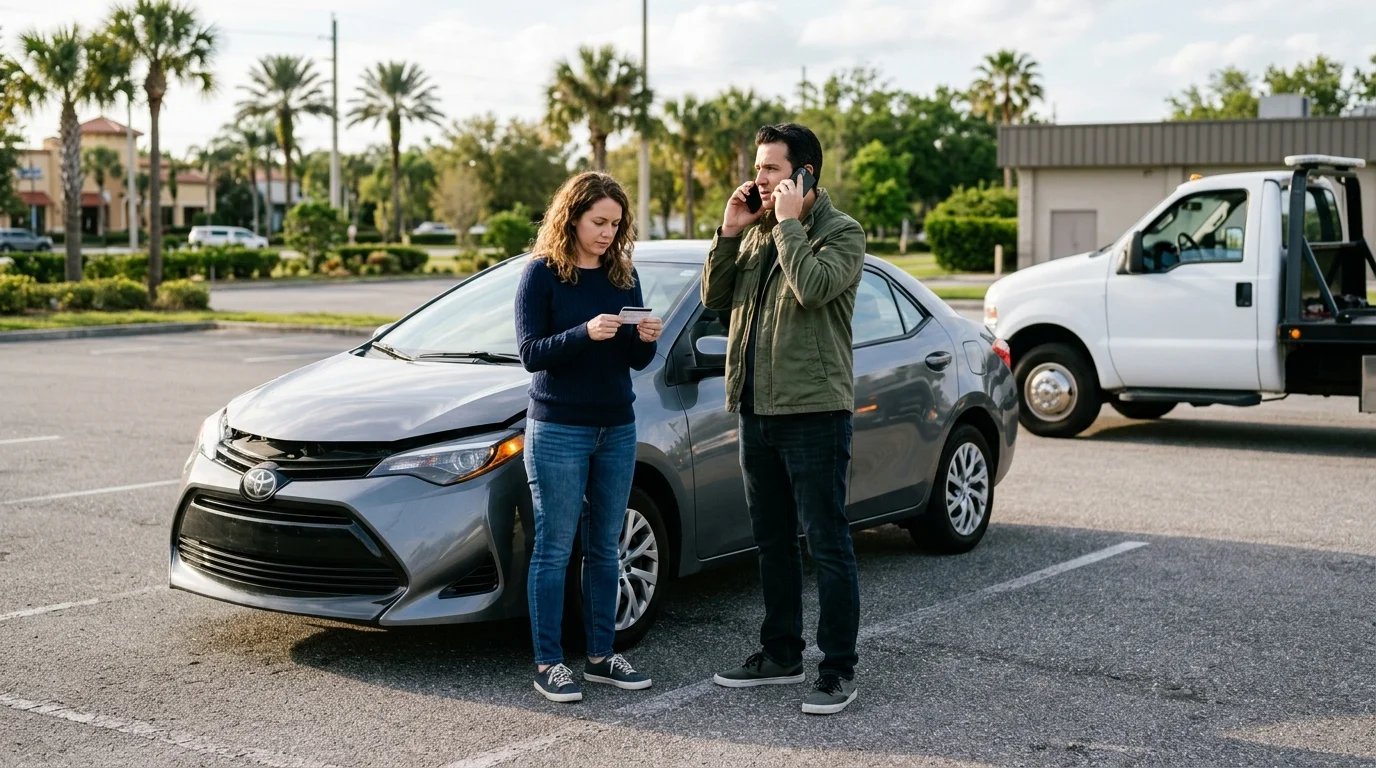
You’re beside a friend’s disabled car in an Orlando parking lot. Your roadside card is the only one available. Your coverage might arrange the tow, but there isn’t one answer for every policy or plan.
The result depends on whose plan it is, which vehicle needs help, who is present, and the current terms. Confirm those details before authorizing service or expecting reimbursement.
Start with whose plan and vehicle are involved
Begin by identifying the people, vehicle, and coverage involved. Don’t assume roadside benefits automatically follow you into every car. Don’t assume they stay with one listed vehicle, either. The provider’s current terms control that answer.
Write down these details before making a call:
- The name on the insurance policy or roadside plan
- The owner of the disabled vehicle
- The person who was driving
- Whether the covered person is at the vehicle
- The vehicle’s year, make, model, and location
- The address where the vehicle needs to go
These details help the provider decide whether the event fits the plan. An insurance card alone doesn’t confirm that another person’s vehicle qualifies. It also doesn’t show whether the benefit applies to a member, a listed vehicle, or both.
Several situations can look similar but receive different answers. You might be driving your friend’s car near Winter Park. Your friend might be driving while you’re riding along. You might be across Orlando while their car sits near Lake Nona. Each situation involves a different combination of person, vehicle, and location.
Ask one direct question: “Does my current roadside benefit cover this specific vehicle with this driver?” Give the representative the actual vehicle information. Avoid describing the car as yours when it belongs to someone else.
If the provider can’t confirm coverage, ask what document contains the rule. Check the policy, roadside agreement, mobile account, or benefit summary. Quick Tow Orlando can’t interpret an insurer’s contract or decide whether a claim qualifies. We can connect customers with local operators for roadside assistance when they need help in the Orlando Metro.
Separate roadside benefits from insurance reimbursement
Roadside service and insurance reimbursement aren’t the same arrangement. Keeping them separate prevents confusion when another person’s car needs towing.
A direct roadside benefit means you contact the plan before arranging service. The plan then decides whether the event and vehicle qualify under its current terms. If approved, it may explain how the tow must be requested. Don’t assume you can select any operator and send the receipt afterward.
Reimbursement is different. In that situation, someone may arrange and pay for the service first, then submit documents for review. Submission doesn’t guarantee payment. The insurer or plan can still decide whether the driver, vehicle, destination, service, and paperwork meet its terms.
Ask the provider these questions before approving the tow:
- Is this a direct roadside benefit or a reimbursement process?
- Does the disabled vehicle qualify under my plan?
- Must service be arranged through the provider?
- What records should I keep?
- Are there destination or service limits in my documents?
- Who must authorize the tow?
Get the answer for the specific event. A general statement about “towing coverage” may not resolve whether it applies to someone else’s car.
Our Florida towing insurance guide explains the broader coverage issue. For this situation, focus on the relationship between the plan holder and the disabled vehicle.
If you’re asking, “Can I use my insurance to tow another car?” the safest answer is that we couldn’t confirm one rule covering every policy. Ask your provider before treating the service as covered. If you authorize a tow without that confirmation, be prepared for the possibility that reimbursement may be denied.
Check whether the covered person must be present
Your location may matter as much as the vehicle’s ownership. Some plan documents may distinguish between a covered person who is at the breakdown and someone requesting help from elsewhere. Only the provider can confirm how your current plan handles that difference.
Tell the provider exactly where everyone is. For example, you may be standing with a friend’s car near International Drive. You could also be calling from Kissimmee while the vehicle is parked in Orlando. Those aren’t identical requests.
Ask whether the covered person must:
- Be at the disabled vehicle
- Have been driving or riding in it
- Show identification or plan information
- Remain present until the operator arrives
- Speak directly with the provider
- Approve the destination
These are questions, not universal requirements. Don’t tell the provider that you’ll be present if you won’t be. A mismatch between the request and the situation could delay the decision or affect how the plan reviews the service.
If someone else is waiting with the car, give the provider that person’s name and contact details. Confirm what information the operator may need at the scene. The driver who arrives may also need clear access to the vehicle and accurate destination instructions.
Location details matter around Orlando. “Near I-4” isn’t enough for a service request. Use the nearest safe address, parking area, exit, or cross street. Say whether the vehicle is on a road shoulder, inside a garage, or in a private lot. Never wait in an exposed traffic lane to settle a coverage question.
If the plan doesn’t apply, you can still ask about same-day roadside assistance without a membership. Confirm the service terms before authorizing the operator.
Confirm authorization before requesting the tow
Coverage approval doesn’t replace permission to move someone else’s vehicle. Confirm that the owner knows about the request, approves the destination, and can provide any documentation the operator requires.
Start with the vehicle owner. Ask where the car should go and whether a repair shop is expecting it. Get the correct address. “The shop near SR 408” can point to several different places.
Don’t guess about ownership or sign another person’s name. If the owner can’t be present, ask the provider and operator what authorization they accept. We couldn’t confirm one documentation rule that applies to every voluntary tow. The acceptable process can depend on the provider, operator, vehicle, and circumstances.
Have these details ready:
- Vehicle owner’s full name
- Current vehicle location
- Requested destination
- Keys or access information
- Name of the person meeting the operator
- Provider approval or reference details, if issued
A car inside an apartment lot, hotel garage, repair facility, or gated community may also require access coordination. Tell the operator about gates, clearance restrictions, locked wheels, missing keys, or blocked parking spaces. These details help the operator evaluate the job before accepting it.
Authorization becomes especially important when the plan holder isn’t present. The roadside provider may approve a benefit, while the towing operator still needs enough information to move the vehicle properly. Treat those as separate decisions.
For a disabled car that needs transport instead of a jump-start, tire change, or lockout service, ask whether emergency towing fits the situation. Quick Tow Orlando takes calls at any hour, dispatches Monday to Friday from 8 a.m. to 10 p.m., and connects customers with independent local operators. The operator confirms the service details before the truck rolls.
Ask the provider before assuming the call is covered
Call the insurance company or roadside plan first when coverage matters. Describe the exact situation in one sentence: “I’m the covered person, the car belongs to my friend, and I’m present with it in Orlando.” If you’re absent, say that instead.
Then ask for a clear answer on these points:
- Is this person covered?
- Is this vehicle covered?
- Must the covered person remain at the car?
- Can the owner choose the destination?
- Must the provider arrange the service?
- Is this handled directly or through reimbursement?
- What documents should be saved?
Record the date of the conversation and any reference information the provider gives you. Keep the service receipt and related records if you plan to request reimbursement. Don’t assume a reference number guarantees payment. It may only identify the conversation or service request.
If the provider gives an unclear answer, ask where the applicable term appears in writing. Read the section that addresses covered people, eligible vehicles, roadside events, towing, and reimbursement. Marketing language may be shorter than the actual agreement.
You should also confirm what happens if the roadside benefit doesn’t apply. Ask whether you may arrange service independently. Then tell the operator that coverage hasn’t been confirmed. That keeps the service decision separate from any later insurance review.
Don’t delay a safety decision while debating benefits beside I-4, SR 417, SR 429, or the Turnpike. Move away from active traffic when possible, and share a precise location. Coverage can be checked from a safer place.
Quick Tow Orlando can’t promise that an insurer or membership plan will cover another person’s vehicle. We can take the service details, match the request with a local operator, and let you decide whether to authorize the job.
When to call us
Call when someone else’s disabled car needs professional transport, especially when it can’t be moved safely or roadside service won’t solve the problem. Confirm insurance or plan terms first if coverage affects your decision. Call us at (321) 321-9797.