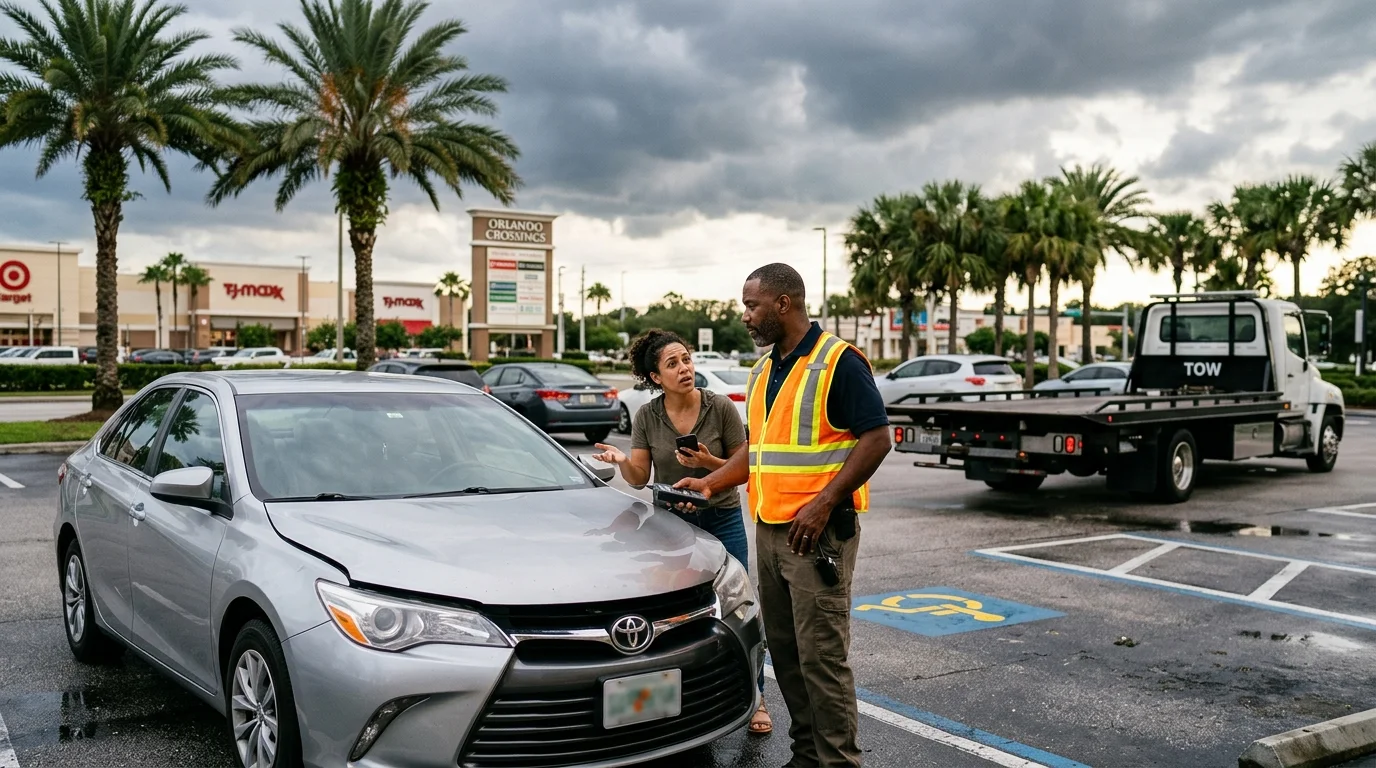
Roadside help may be available the day you need it. However, a membership purchased today might not cover today’s breakdown. Same-day access depends on the provider’s current activation, waiting-period, and service rules.
If coverage can’t be confirmed, pay-per-call help offers another option. You can request service without joining a membership plan.
Start with whether you need help right now
Your immediate situation should guide the first call. A dead battery in Winter Park is different from a stalled car beside I-4. Decide whether you can safely wait and what service the vehicle needs.
Move away from traffic when you can do so safely. Turn on the hazard lights and stay aware of passing vehicles. Don’t attempt a repair beside an active lane if it exposes you to traffic.
Next, identify the basic problem. Common roadside requests include a jump-start, tire change, lockout, or fuel delivery. Our roadside assistance network connects callers with local operators for these situations. Quick Tow Orlando doesn’t sell a roadside membership or perform the repair itself.
If you already have a plan, contact its provider first. Ask whether your account is active for the breakdown happening now. Don’t rely only on a confirmation email, app screen, or membership card. Those items may confirm enrollment without confirming immediate service eligibility.
Tell the provider that the vehicle is already disabled. Ask whether joining today changes how the current event is handled. Get a direct answer before authorizing outside help or assuming reimbursement will follow.
If the provider can’t confirm coverage, consider pay-per-call assistance. This means requesting the needed service directly instead of filing it under a membership. The operator should explain the requested service before you approve it.
Location matters in Orlando. Share whether you’re in a parking lot, garage, driveway, or roadway. Mention nearby landmarks and access restrictions. A vehicle near International Drive may require different access details than one parked at a Lake Nona apartment complex.
How membership activation can differ from pay-per-call help
A roadside membership and a pay-per-call request are different arrangements. A membership creates an ongoing relationship with a plan provider. Pay-per-call assistance addresses the current problem without requiring enrollment.
Buying a same day roadside assistance membership doesn’t automatically prove coverage starts immediately. The provider’s written terms control activation. A plan may distinguish between the enrollment date, account activation, and eligibility for a first request. Those distinctions must be confirmed with that provider.
Ask one direct question: “Will this plan cover the breakdown that has already happened today?” Then ask where that answer appears in the current terms. Save the written response when possible.
Pay-per-call help avoids the membership activation question. You describe the problem, location, and vehicle. The request is then treated as a standalone service. That doesn’t mean every issue can be resolved beside the road. The operator who responds must assess the vehicle and working conditions.
This distinction also matters when comparing costs. Membership dues, service charges, and pay-per-call charges aren’t interchangeable. Quick Tow Orlando publishes no rate card. Confirm the charge and payment terms before approving service.
Our guide to finding affordable roadside assistance in Orlando explains what to compare without assuming the lowest quoted amount fits every situation. Ask what the requested service includes and what circumstances could change it.
Roadside assistance without membership can make sense when help is needed now. A membership may suit drivers planning for future incidents. The right choice depends on confirmed terms, not the plan’s name or marketing language.
What to check for waiting periods and service limits
Read the current plan terms before purchasing coverage for an existing breakdown. If the wording isn’t clear, contact the provider and ask for written clarification. Don’t assume “active today” means every service is available today.
Start with the waiting period. Ask whether any delay applies after enrollment. Confirm when that period begins and whether the current breakdown is excluded. No waiting-period rule could be confirmed for membership plans generally, since each provider sets its own terms.
Next, ask about service limits. Confirm which roadside events the plan covers. A jump-start, lockout, tire problem, fuel request, and tow may be handled differently. Don’t assume coverage for one service proves coverage for another.
Ask whether the plan limits where service can occur. Your location could be a gated community, parking garage, private lot, or controlled-access roadway. Explain those conditions before opening the request.
Coverage limits also need a plain answer. Ask what the provider pays, what the driver may owe, and how added charges are handled. Don’t approve work based on an unconfirmed assumption about full coverage.
Reimbursement deserves separate attention. Some arrangements may require the driver to pay first and submit documents later. Ask whether outside service is eligible before hiring an operator independently. Confirm which receipt, authorization, or claim documents the provider requires.
Drivers should also review any roadside benefits connected to existing coverage. Our guide to towing and Florida car insurance explains why the policy itself must be checked. Coverage can’t be confirmed from the insurer’s name alone.
Finally, ask how the provider treats a breakdown that began before enrollment. That answer is central to any same-day request. If the representative can’t confirm it, don’t treat the service as covered.
What details to share before requesting roadside help
Accurate details help the operator understand the request. Start with your exact location. A street address is helpful, but it may not identify the correct entrance, garage level, or side of a large shopping center.
Share a nearby business, cross street, mile marker, or exit when available. On SR 408, SR 417, SR 429, or Florida’s Turnpike, include your travel direction. Don’t cross active traffic to inspect a sign or marker.
Describe the vehicle clearly. Provide its make, model, color, and approximate size. Mention whether it’s a car, pickup, motorcycle, van, or vehicle pulling a trailer. Tell the operator about low clearance, modified wheels, or restricted garage height.
Explain what happened without diagnosing beyond what you know. “The engine won’t crank” is more useful than guessing that the alternator failed. Say whether warning lights appeared, the tire is damaged, keys are locked inside, or the vehicle has visible collision damage.
Also describe the vehicle’s position. Tell the operator whether it’s in a marked space, blocking traffic, stuck against a curb, or unable to shift. Mention tight turns, locked gates, soft ground, or standing water.
Before requesting service through a membership, have the plan information ready. Ask the provider to confirm that the request has been accepted under the account. Keep any authorization details it gives you.
For pay-per-call help, ask what service is being requested on your behalf. Confirm the payment method and any information needed at the scene. Quick Tow Orlando can connect you with a local operator, but the responding operator determines what can safely be done after assessing the vehicle.
Keep your phone available after placing the request. If you move to a safer location, share the updated position. Clear information reduces confusion in crowded Orlando parking areas and along major routes.
When the vehicle needs a tow instead
Roadside help works best when a limited service can make the vehicle usable again. A tow becomes the better request when the car can’t be safely driven or repaired where it stopped.
Visible collision damage is one warning sign. So are leaking fluids, smoke, severe wheel damage, or a vehicle that won’t remain running. Don’t keep driving simply to avoid changing the service request.
A spare tire also doesn’t solve every tire problem. The vehicle may lack a usable spare, have multiple damaged tires, or be positioned where a roadside change isn’t safe. Tell the operator what you can see without entering traffic.
Battery symptoms can also hide another issue. A jump-start may not help if the vehicle has a different mechanical or electrical fault. The operator who arrives can assess whether the requested roadside service is suitable. If not, the vehicle may need transport.
Ask where the vehicle should go before approving a tow. That could be your home, a repair shop, or another lawful destination. Confirm that the destination can receive the vehicle. Don’t assume a closed property allows unattended drop-off.
Membership towing terms still require confirmation. Ask whether towing is active that day, what limits apply, and whether authorization is needed before the vehicle moves. If the plan won’t cover the current incident, you can request pay-per-call emergency towing instead.
Quick Tow Orlando connects callers with local tow operators. We don’t own the trucks or perform the tow. Share the vehicle’s condition, location, and destination so the request can be matched appropriately.
When to call us
Call when your vehicle needs roadside help or can’t be safely driven. We’ll answer, gather the situation details, and connect you with a local tow operator. Call us at (321) 321-9797.