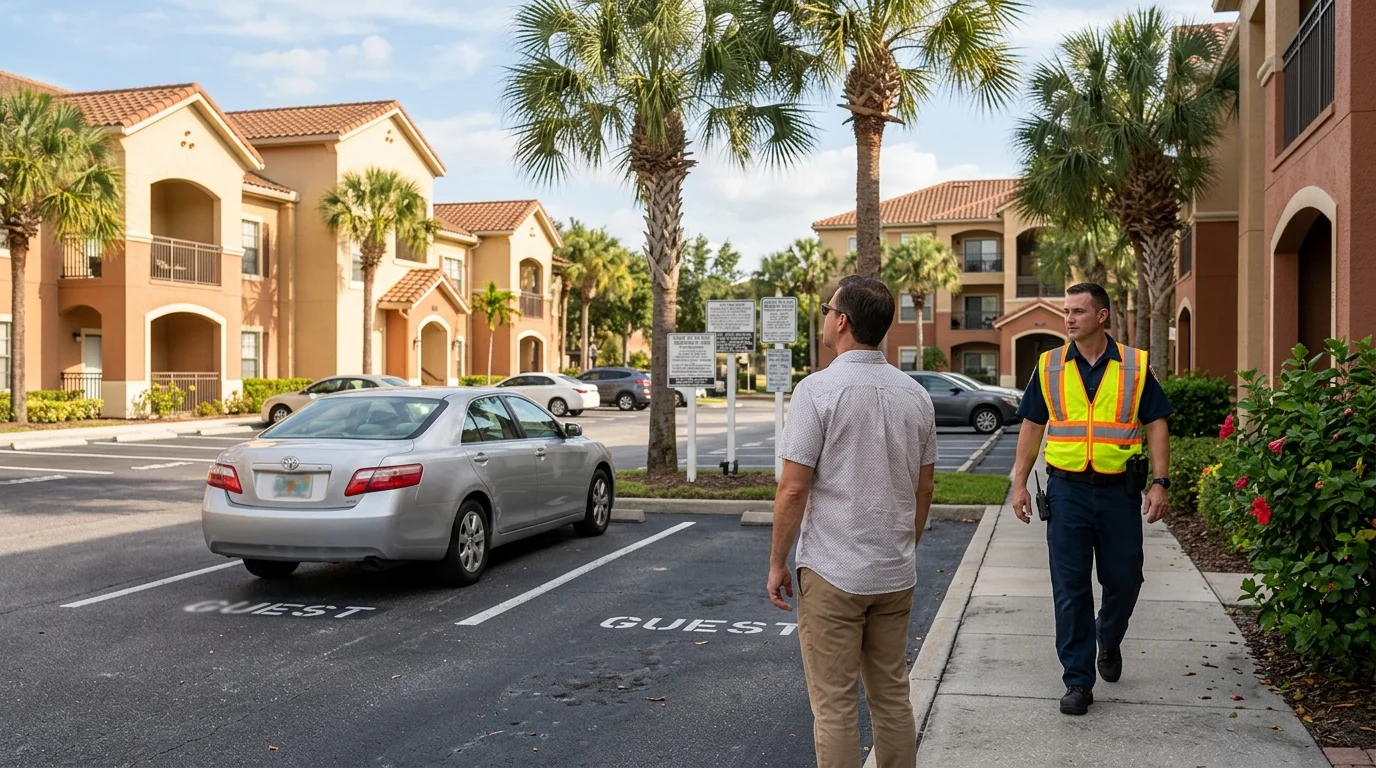
Yes. A Florida apartment may arrange the removal of a guest’s car when it’s wrongfully parked on private property. The reason, posted notice, and authorization all matter, so identify the exact space and rule before anyone acts.
Start with where and why the guest parked
Begin with the parking space itself. Was the car in a marked visitor area, a resident-only row, a reserved space, or an unmarked section? Photograph the surrounding pavement markings and nearby signs before the car moves.
Next, identify why the apartment considers the vehicle unauthorized. The issue might involve a missing visitor permit, an expired temporary pass, parking outside designated guest spaces, or a plate that wasn’t registered through the property’s system. These are possible property rules, not statewide rules. Check the lease, parking addendum, visitor instructions, and posted notices for the actual restriction.
A space that looks open isn’t necessarily guest parking. Likewise, a paper or digital permit doesn’t answer every question. The permit may apply only to certain spaces, dates, or vehicles. Compare the guest’s parking location with the exact language supplied by management.
Don’t confuse guest parking with an assigned-space dispute. If another resident says the guest took a reserved space, management should verify that assignment. A resident’s statement can start the review, but it shouldn’t replace the property’s records.
The location also matters because local guidance may differ. Confirm whether the property falls within the City of Orlando or another Orange County jurisdiction. An Orlando mailing address alone shouldn’t be your only check. Ask management which current local rules apply to that property.
For property managers, private property towing should follow a repeatable process. Confirm the location, violation, notice, and authorization before contacting an operator.
Check permits, posted signs, and property rules
Florida’s private property towing statute sets notice standards for most nonconsensual tows. Under Florida Statute 715.07, property owners must post compliant notices before towing without the vehicle owner’s consent. The statute lists exceptions for single-family residences and situations involving personal notice.
The required signs include several specific features:
- “Tow-away zone” must appear in letters at least four inches high.
- The lettering must be light-reflective against a contrasting background.
- The towing company name and current telephone number must appear.
- Each sign must be permanently installed three to six feet above ground.
The signs must remain in place for at least 24 hours before towing begins. Placement also matters. The statute calls for one sign per 25 feet of lot frontage, or a sign at each driveway access point within 10 feet of the road.
Our guide to Florida private property towing signs explains those details further. Use it alongside the current statute, not as a substitute for reading the posted notice.
Sign compliance and apartment rules are separate checks. A compliant entrance sign doesn’t tell a visitor which spaces require permits. A parking addendum doesn’t eliminate the need to review Florida’s notice requirements. Check both.
If the vehicle displays a visitor permit, record what can be seen without entering it. Note where it appears and whether its details match the apartment’s records. Don’t guess whether a faded, damaged, or partially hidden permit is valid. Ask management to confirm the status through its own system.
Separate management authority from a resident’s request
A resident may report an unfamiliar vehicle, blocked access, or apparent parking violation. That report doesn’t prove the resident has authority to order a nonconsensual tow. It only gives management a reason to check.
Florida’s private property towing rules describe responsibilities tied to the property owner. We couldn’t confirm a statewide rule allowing any apartment resident to authorize a tow simply because that person holds a lease. The apartment should identify the manager, owner representative, or other person permitted by its records to approve removal.
This distinction protects everyone involved. A resident may misunderstand the parking map. A visitor permit may not appear in the expected location. Another employee may already have approved temporary parking. Management can compare the report with its current records before directing an operator.
The person authorizing removal should be able to identify four things: the property, the vehicle, the violated rule, and their authority to act. If any point remains unclear, pause and verify it. Don’t turn a disagreement between neighbors into a towing decision without documented management review.
The towing operator should also receive accurate information. That includes the vehicle description, parking location, stated violation, and authorized contact. This is a practical documentation step, not a claim that one statewide form applies to every Orlando apartment.
Residents should route complaints through the property’s established process. They shouldn’t represent themselves as management or contact an operator as though they control the lot. If the apartment’s policy doesn’t identify who may approve a tow, ask the property manager for written clarification.
What to document before the vehicle is removed
Good records should show what happened without relying on memory. Take wide photos showing the vehicle within the parking area. Then take closer photos of the space markings, visible permit location, nearby rule notice, and license plate.
Record the date, time, building or lot section, space number, and stated reason for removal. If the property uses digital visitor registration, preserve the relevant entry or absence shown in the system. Don’t change a record after the tow to make it fit the decision.
Photograph the route a driver used to enter the lot. This helps establish which towing notice was visible at that entrance. Include enough surrounding detail to identify the location, but avoid photographing unrelated residents more than necessary.
The authorization record should name the management representative who approved the removal. It should also identify the operator contacted. If a resident made the original report, keep that separate from the final management decision.
Visitors can document the scene too. Take photos of the parked position, signs, permit, and any instructions supplied by the resident or leasing office. Save parking registration confirmations and messages about guest approval. These records won’t decide the dispute by themselves, but they can preserve details that disappear after removal.
Don’t enter, unlock, or move the vehicle just to create better documentation. Record what can be observed from outside. If the car creates an immediate safety concern, describe the condition accurately when contacting management or the appropriate authority.
Whether the apartment sits near International Drive, Lake Nona, or Winter Park, the same practical principle applies. Document the exact property and exact parking rule. Generic photos of a vehicle won’t show why that particular space mattered.
What the owner should verify after a tow
First, confirm that the car was towed rather than stolen or moved by another authorized user. Contact apartment management and ask which operator removed it. Request the storage location, removal time, stated violation, and management contact who authorized the tow.
Our guide on finding a towed car in Orlando explains how to organize that search. Don’t call random yards or rely only on an online comment about the property.
For a private property tow in Orange County, verify the storage address. Florida’s approved statutory distance rules place storage within a 10-mile radius of the tow origin in counties with at least 500,000 residents, including Orange County. If no storage facility is available within that radius, the maximum extends to 20 miles.
Ask the yard what documents and payment methods it currently accepts before traveling there. We couldn’t confirm specific Orange County or City of Orlando towing rate caps from accessible primary sources. Request the current charges directly, then compare them with the applicable local guidance. For help with an Orange County towing complaint, review Orange County Consumer Protection.
Florida’s private property towing rules also include release protections. The property owner or towing company must release the vehicle within one hour after the owner’s request. The owner may inspect the vehicle before accepting it. The towing company can’t require a no-release or waiver clause as a condition of redemption.
Florida’s wrecker lien law says storage fees can’t be assessed when a vehicle is held for fewer than six hours. Vehicle owners must also be allowed to inspect and retrieve personal property within one hour after presenting appropriate documentation during business hours.
Inspect the car before leaving and document any concerns. Ask for an itemized explanation of the amount requested. If something doesn’t match the posted notice or stated reason, keep the records and follow the steps in our guide to rights after an Orlando tow.
When to call us
Property managers should involve a tow operator when an unauthorized guest vehicle needs professional removal and the property has verified its records. Quick Tow Orlando connects callers with independent local towing operators across the Orlando Metro. Call us at (321) 321-9797.