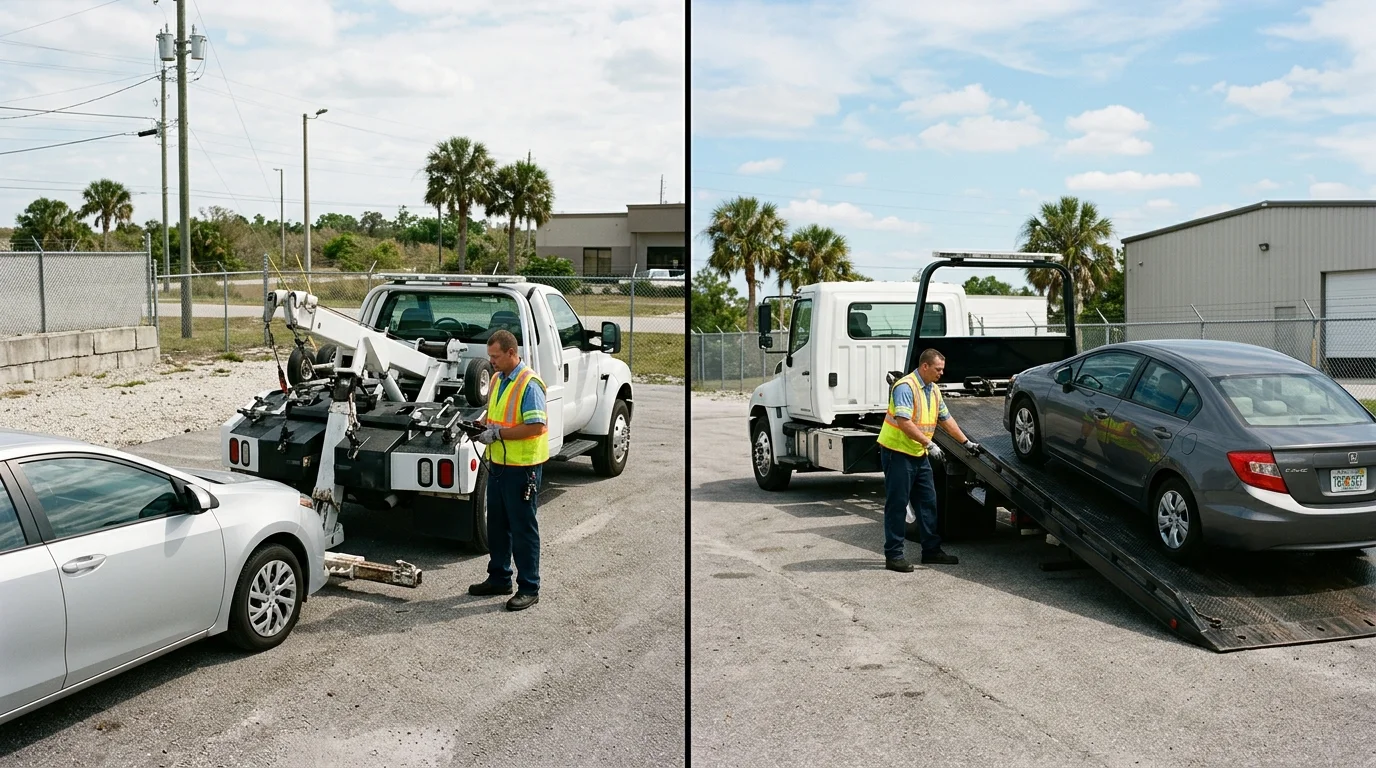
The wheel lift vs flatbed towing choice depends on your drivetrain, vehicle condition, clearance, and manufacturer instructions. A wheel lift can suit a car that may roll safely on one axle. A flatbed keeps every wheel off the road during transport.
Neither truck is automatically right for every breakdown. The operator needs accurate details before choosing equipment. That matters in an Orlando parking garage, on a narrow Winter Park street, or beside I-4.
How each truck supports the vehicle
A wheel-lift truck raises one end of the vehicle. Its lifting assembly supports the tires on one axle. The tires on the other axle remain on the road and roll during the tow. Which end gets raised depends on the vehicle and its approved towing method.
That compact setup can help where working space is limited. It may be easier to position inside some parking garages or along crowded urban streets. The operator still needs enough room to approach, connect, and leave without contacting nearby cars or structures.
A flatbed uses a carrier deck rather than leaving one axle rolling. The vehicle is loaded onto that deck, then secured for transport. All four tires remain off the road once loading is complete. Our flatbed towing guide explains when callers may need that type of carrier.
The difference isn’t simply truck size or appearance. It’s how the vehicle is supported while moving. That affects which drivetrain components may turn, how damaged wheels are handled, and whether the car can follow its manufacturer’s towing instructions.
A flatbed also needs a workable loading path. The deck must be positioned near the vehicle, and the operator must account for slope, clearance, and surrounding traffic. A wheel lift has its own access needs. Tight spaces don’t guarantee that either option will fit.
The right answer comes from matching the truck to the exact car and scene. Vehicle condition can also change after a crash, curb strike, or tire failure. That’s why the operator should confirm the setup before moving anything.
When a wheel lift is a practical choice
Wheel-lift towing may be practical when the vehicle’s approved procedure allows one axle to roll. The wheels staying on the pavement must also be suitable for that job. Drivetrain layout alone doesn’t settle the decision.
Access can make a wheel lift useful around Orlando. Downtown garages may have ramps, columns, low overhead areas, and sharp turns. International Drive lots can become crowded around entrances and pickup zones. A compact towing setup may offer a better approach, but the operator must inspect the actual route.
Vehicle condition matters just as much. The operator needs to know whether the tires hold air and the wheels turn. Steering position, parking-brake status, and visible damage can change the plan. A wheel lift that fits the space still isn’t suitable if the car can’t travel that way.
Don’t select wheel-lift towing only because the trip seems short. Distance doesn’t override the manufacturer’s instructions or the vehicle’s mechanical condition. A short move can still require a different setup.
Tell the operator if the vehicle sits unusually low or has modified bodywork. Share whether it’s parked nose-in, backed against a wall, or trapped between other cars. Photos of the vehicle and its surroundings can help explain access without guessing.
A wheel lift is a practical choice when the car, towing procedure, and scene all support it. The operator may also determine that added equipment or another truck is needed. The goal is a method suited to that specific vehicle, not a default chosen from the street name.
When the car needs a flatbed instead
A flatbed may be the better option when the vehicle shouldn’t roll on its tires during transport. That can include situations involving drivetrain restrictions or suspected damage. The operator should verify the condition before loading.
Wheel, tire, steering, or suspension damage deserves particular attention. A tire can appear to be the only problem while nearby parts have also been affected. If a wheel sits at an unusual angle, don’t assume it can roll onto the road. Describe what you see and avoid moving the car yourself.
Low-clearance vehicles may also need a carefully planned flatbed load. The operator must consider the loading angle, lower body panels, and available space. Flatbed isn’t a magic word that removes every clearance problem. It gives the operator a different support method and loading path.
Older, restored, or modified cars often need vehicle-specific planning. Our guide to classic car towing in Orlando covers details worth sharing before the operator arrives. That includes modifications and known lifting restrictions, not invented rules based only on the car’s age.
A crash scene can make the choice more complicated. Debris, locked wheels, displaced panels, and the car’s final position may affect recovery. On I-4, SR 408, or SR 417, the traffic environment also shapes how the operator approaches the vehicle. Equipment selection must account for both the car and the scene.
Ask for a flatbed when the vehicle instructions require one or the operator recommends it after inspection. Don’t treat it as automatically superior for every car. The best truck is the one that supports the vehicle correctly under the conditions present.
How drivetrain and damage change the decision
Start with the drivetrain: front-wheel drive, rear-wheel drive, all-wheel drive, or four-wheel drive. If you’re unsure, tell the operator the year, make, model, and trim. Don’t guess from the vehicle’s shape or badge placement.
The operator must determine which wheels can remain on the pavement. Some vehicles have model-specific instructions about wheel position, transport settings, or added equipment. Follow the manufacturer’s current procedure for that exact vehicle. Advice for a similar model may not apply to yours.
Neutral doesn’t answer every towing question. It describes a selected gear position, not the full condition of the drivetrain, brakes, steering, or damaged parts. A car that shifts into neutral may still need a flatbed or another setup.
All-wheel-drive and four-wheel-drive vehicles need careful identification. Tell the operator about any selectable drive modes, drivetrain warnings, or dashboard messages. If you don’t know the configuration, check the owner’s manual or current manufacturer information. The operator can then match the vehicle with an appropriate method.
Electric vehicles also require model-specific instructions. Battery location, transport settings, and wheel movement shouldn’t be assumed from another electric car. Read our guide on whether a Tesla can be towed normally before treating one Tesla procedure as a rule for every model.
Damage can override the usual plan for an otherwise familiar vehicle. A collision may affect steering, suspension, wheels, or body clearance. A curb strike may leave damage that isn’t obvious from the driver’s seat. Floodwater or an electrical fault may prevent normal controls from working.
Don’t crawl beneath a disabled vehicle to diagnose it. Share visible details from a safe position. The operator can inspect the car and choose the support points, loading method, and equipment. If the vehicle is in active traffic, focus on personal safety and communicate its exact location.
What to tell the operator before dispatch
Good information helps the operator avoid arriving with a truck that doesn’t match the car or access point. Start with the vehicle’s full description. Include the year, make, model, trim, and drivetrain when known.
Then explain the problem in plain terms:
- Say which tire, wheel, or corner appears damaged.
- Mention collision damage, leaking fluids, or loose body panels.
- Tell the operator whether the engine starts.
- Explain whether the transmission selects neutral.
- Report any steering, brake, or drivetrain warning shown.
- Mention an electronic parking brake that won’t release.
- Describe lowered suspension, body kits, or other modifications.
- Share the manufacturer’s towing instructions if you have them.
Describe the pickup location with equal care. A street address alone may not explain a difficult approach. In an Orlando garage, provide the garage name, level, entrance, and posted clearance. Mention ramps, sharp turns, gate access, and whether the car is against a wall.
For an outdoor pickup, identify the road and direction of travel. A location beside the Turnpike isn’t specific enough without an exit, landmark, or nearby sign. On International Drive, say whether the vehicle is in a travel lane, parking lot, loading area, or garage.
Photos can clarify wheel position, body damage, and available space. Take them only from a safe location. Don’t step into moving traffic or stand between the disabled car and approaching vehicles.
Also provide the destination and any access concerns there. The operator may need to place the vehicle in a repair-shop lot, driveway, or another approved location. A narrow destination can affect equipment planning just as much as the pickup point.
Quick Tow Orlando can match callers with a local operator based on the details provided. The operator makes the final equipment decision after considering the vehicle, scene, and current manufacturer instructions.
When to call us
Call when the vehicle can’t be moved safely or you’re unsure whether it needs a flatbed or wheel lift. We’ll connect you with a local tow operator who can assess the drivetrain, damage, clearance, and pickup location. Call us at (321) 321-9797.