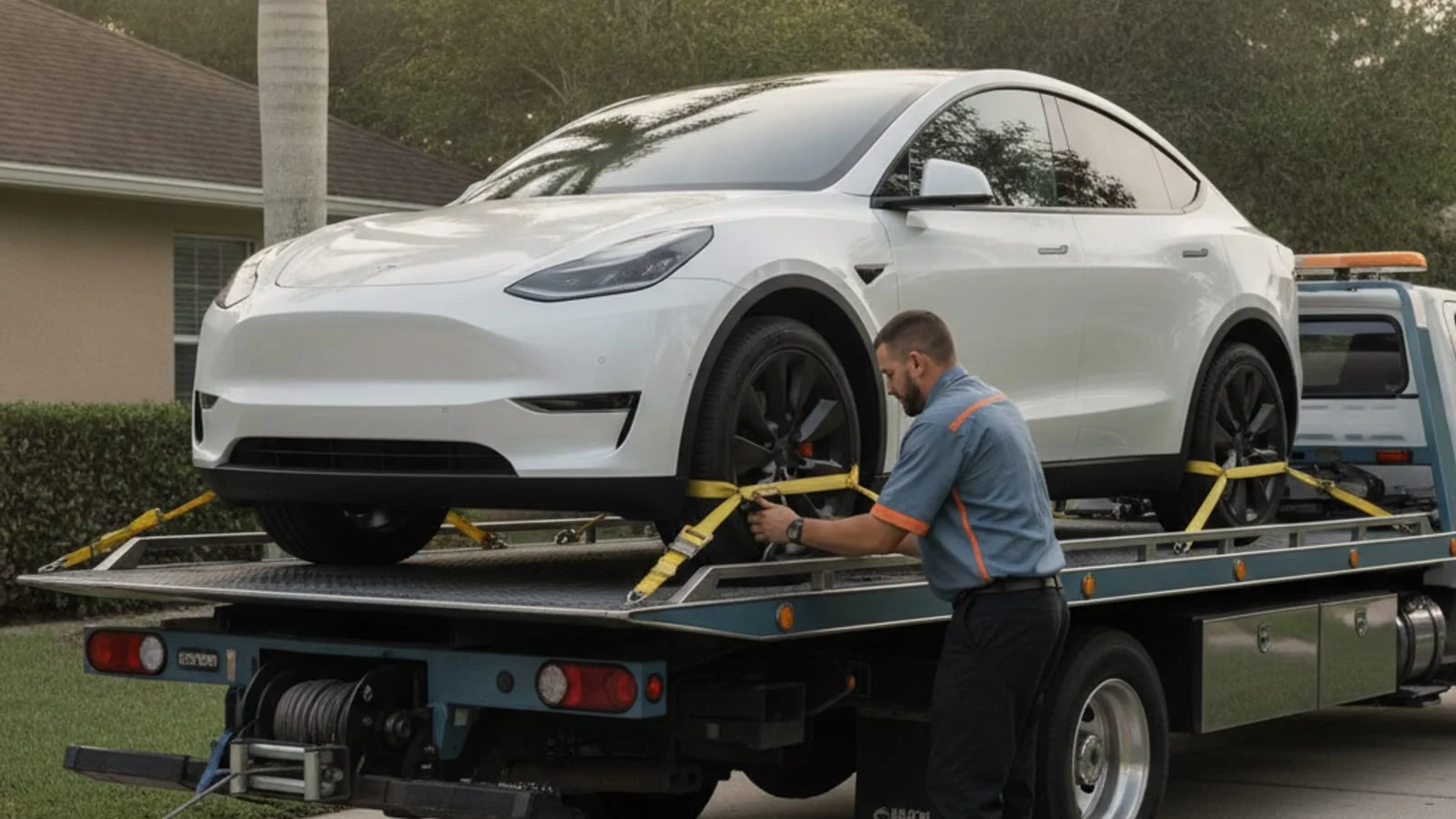
Owners keep asking can Teslas be towed normally, and the short version is no, not the way a conventional car is towed. The safest default is a flatbed, unless that specific car’s current owner documentation approves another transport method.
That distinction matters on I-4, inside a Lake Nona garage, or anywhere else. A rushed hookup can turn a simple breakdown into a larger repair problem.
Can Teslas be towed normally: the short answer
Don’t request a normal two-wheel tow for a Tesla. Ask for a flatbed towing operator and identify the exact vehicle before anyone heads your way.
A flatbed carries the vehicle with its tires off the road. That avoids making the car’s wheels and drivetrain roll throughout the trip. It also gives the operator one clear loading plan before reaching the scene.
The single exception is another method expressly allowed by that car’s current owner documentation. Such a setup may use a wheel lift with supporting dollies. The key difference is that it doesn’t leave one pair of tires rolling along the pavement.
That isn’t permission to improvise. Tesla procedures can differ between vehicles, configurations, and software versions. We couldn’t confirm one universal procedure that applies to every Tesla. Check the owner’s documentation tied to the exact car. The operator should also confirm the approved method on scene.
A short movement during loading isn’t the same as towing the car down the road. An operator may need the wheels to roll while positioning the vehicle onto a carrier. That controlled loading step should follow the car’s documented instructions.
If someone proposes lifting one end and letting the other tires roll, pause the job. Show them the vehicle information and the relevant owner documentation. Request a flatbed or another documented all-wheels-off-road setup.
The simple answer is no, Teslas can’t be towed normally in every situation. Treat flatbed transport as the default. Treat any alternative as vehicle-specific, not universal.
What a wheel lift does to an electric drivetrain
A conventional wheel lift raises one end of a vehicle. The tires at the opposite end remain on the road and rotate during transport. That approach works for many cars when the correct axle and procedure are used.
An electric vehicle changes that decision. Rolling tires can turn components connected to its drivetrain. Selecting neutral on the screen doesn’t automatically prove that road towing is allowed. A powered-down vehicle also isn’t necessarily mechanically disconnected.
Tesla drivetrains aren’t identical across every model and configuration. That makes visual guesswork unreliable. An operator can’t safely choose a lifting end based only on the badge, body shape, or where the vehicle stopped.
This is why the towing method should be settled before hookup. Give the operator the model and any useful configuration details. Then confirm that the planned method matches the owner’s documentation.
Don’t allow the car to be dragged with locked tires. Don’t assume a parking release makes ordinary towing acceptable. Those actions can place stress on the tires, drivetrain, steering, or braking components.
The practical goal is simple: prevent the tires from rolling on pavement during transport. A flatbed does that without requiring the operator to choose a road-going axle. A properly approved alternative must accomplish the same goal.
If the car sits at an awkward angle, loading may require careful repositioning. Let the operator decide how to approach the vehicle after inspecting it. The operator may use loading equipment suited to the surface and available clearance.
Getting the car to roll: the mode nobody can find
Getting a disabled Tesla onto a flatbed can be the hardest part. The car may need its loading or transport setting before it can roll freely enough for positioning.
Don’t rely on a menu path remembered from another Tesla. The controls may differ across models and software versions. We haven’t confirmed a single sequence that applies to every vehicle.
Open the owner’s documentation associated with the exact car. Search for its towing, transporting, or roadside instructions. Follow that material with the operator standing beside the vehicle. The operator should confirm each step before loading begins.
Treat the in-car setting as a loading aid. It isn’t blanket approval to pull the car down I-4 or SR 408 with tires on the pavement. The goal is controlled movement onto the carrier, followed by secure transport.
Access can become harder when the car won’t power on. A damaged screen, locked steering, or unavailable controls can prevent the expected setup. Don’t force a wheel, drag the vehicle, or copy instructions from a different model. Tell the operator what isn’t working so suitable loading equipment can be planned.
Parking structures add another constraint. A Tesla disabled inside a Lake Nona or Winter Park garage may have limited overhead clearance. A full-size carrier might not reach the parking space. Have the garage level, the entrance height shown on site, the ramp shape and the vehicle’s position ready before you dial, and leave them in your message.
The first operator may need a staged recovery plan. That could mean moving the car to an accessible loading area before placing it on a flatbed. The operator who arrives should assess that setup on scene.
Keep the key card, phone key, and any available owner documentation nearby. Don’t experiment with unfamiliar controls while traffic moves around you.
Loading in an Orlando afternoon storm
An Orlando afternoon storm changes the loading environment quickly. Visibility drops, pavement becomes slick, and standing water can hide curbs or surface damage.
Move yourself and your passengers away from active traffic first. Don’t stand between the Tesla and the carrier. Stay clear of the cable, loading path, and downhill side of the vehicle.
On I-4, the Turnpike, or another limited-access road, the immediate problem is exposure to traffic. FHP Road Rangers provide roadside help and can relocate a disabled vehicle from the travel lane. They don’t provide the final tow away. FHP can call a private tow at the motorist’s expense.
Use FL511 to check current traffic and incident information. Share your direction of travel, nearest exit, and visible mile marker. A dropped phone pin helps, but it shouldn’t replace those details.
Water depth is another concern. Don’t drive or push the Tesla through standing water to make loading easier. The edge of the pavement may be hard to see. A soft shoulder can also affect where a carrier can safely position.
If the car has been in floodwater, say so during the call. The operator needs to know before approaching and loading it. Don’t attempt to power the vehicle, charge it, or reach beneath it.
Storms also make communication harder. Send the vehicle details and location while your signal is stable. Keep your phone protected and conserve its battery. If you must leave the car for safety, tell the operator where you’ll wait.
Our emergency towing service connects Orlando-area callers with local operators, Monday to Friday from 8 a.m. to 10 p.m. Quick Tow Orlando handles the call and match. The operator who arrives handles the recovery and transport.
What to have ready so the right truck comes
Start with the most important sentence: “This is a Tesla, and I need transport with its tires off the road.” That prevents the job from being treated like a routine wheel-lift pickup.
Then give the exact model shown in the car or its documents. Mention any configuration details you can verify. Don’t guess if you’re unsure. The operator can confirm what matters before loading.
Describe the car’s condition clearly. Say whether it powers on, shifts, steers, or rolls. Mention locked tires, damaged suspension, deployed airbags, collision damage, or possible flood exposure. Explain whether the charging cable is connected.
Location details matter just as much. Say whether you’re on a shoulder, driveway, parking deck, soft roadside, or flooded street. For a garage, share its posted entrance clearance and the level where the car sits. For I-4, SR 408, or SR 417, provide your travel direction and nearest exit.
Give the destination too. The operator needs to know whether the car is going to a service center, repair shop, home, or another approved location. Confirm that the destination can receive the vehicle before transport begins.
Ask what carrying method the operator plans to use. If the answer leaves tires rolling on the road, request clarification against the car’s owner documentation. Don’t approve a method simply because it worked for a different electric vehicle.
Ask for the full proposed charge before an operator is sent. EV transport depends on the vehicle, access, condition, destination, and required loading setup. We won’t invent a universal Tesla towing price. Our guide to Orlando towing costs explains which details to gather before agreeing to a tow.
Quick Tow Orlando takes calls at any hour, dispatches Monday to Friday from 8 a.m. to 10 p.m., and connects customers with local operators. We don’t own the carrier or perform the physical tow. Clear details help us match the situation with an operator prepared to assess it.
When to call us
Call when your Tesla can’t be driven safely, needs flatbed transport, or sits somewhere difficult to access. Quick Tow Orlando can connect you with a local operator who’ll confirm the vehicle-specific loading method on scene. Call us at (321) 321-9797.