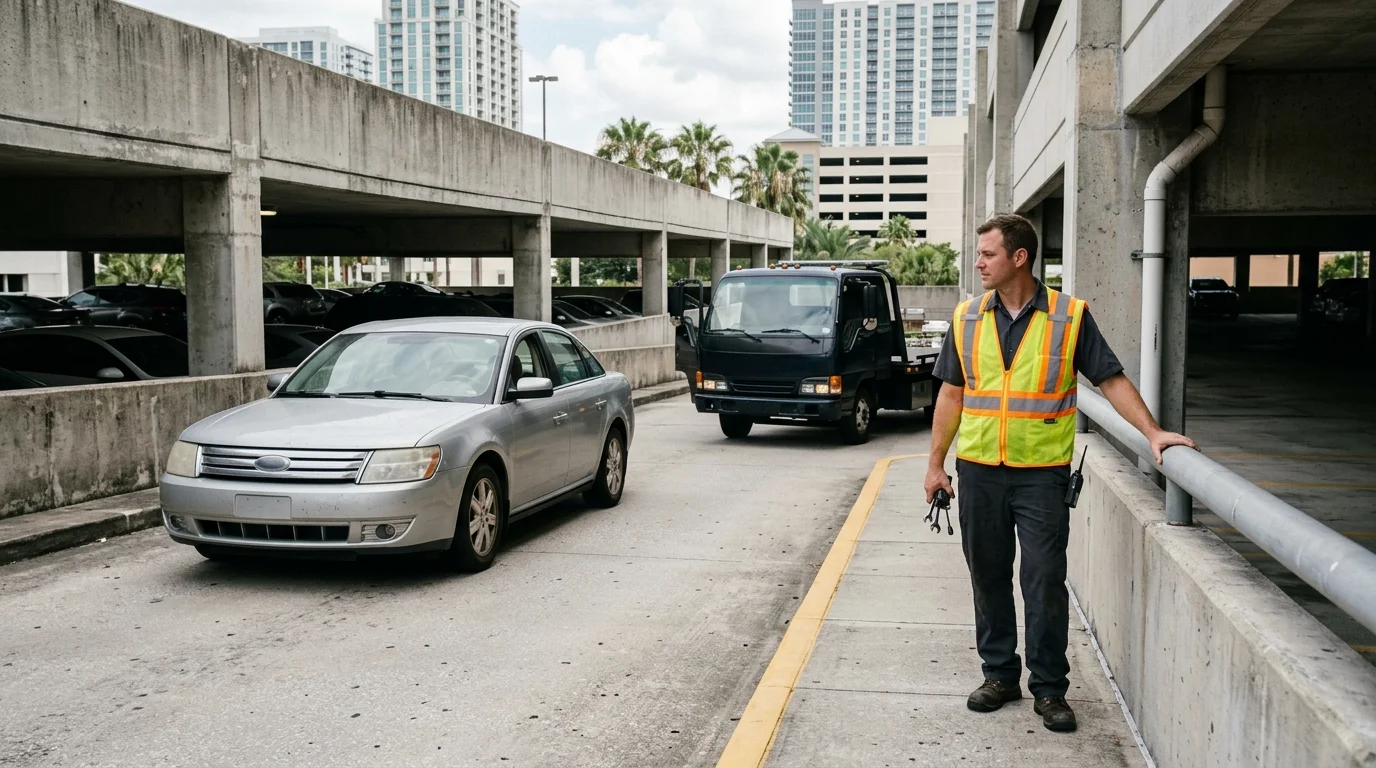
A dead car inside a parking garage creates an access problem, not just a mechanical one. Before requesting towing, gather the garage location, vehicle position, clearance information, and exit details. Those facts help the referred operator decide whether roadside service or towing makes sense.
Get clear of garage traffic first
Start by making yourself visible without standing in a travel lane. Turn on the hazard lights if the vehicle still has power. Move passengers to a protected pedestrian area, such as a marked walkway or elevator lobby.
Don’t stand behind the vehicle or between parked cars. Drivers approaching a ramp may not see you early enough. This matters even more near corners, ticket gates, and narrow entrance lanes.
If the car stopped on a ramp, don’t try rolling it alone. Keep the transmission in park and apply the parking brake. Tell the garage contact or security staff where the car is blocking traffic. Follow any instructions posted inside that specific property.
Smoke, flames, a strong fuel smell, or crash damage changes the situation. Move away from the vehicle and contact emergency services. Don’t open the hood or touch damaged electrical components.
A car sitting safely inside a marked space gives you more options. You may have time to check the symptoms before requesting a tow. A car blocking an entrance, exit, or active lane needs immediate coordination with the property contact.
This advice applies across Orlando, but the surroundings will differ. A garage near Downtown Orlando may have several street entrances. A Lake Nona garage may connect with other buildings or controlled areas. Resort-area properties near International Drive may direct service vehicles through a separate entrance. Don’t assume the entrance you used is also the right entrance for a tow operator.
Check whether roadside help can solve the problem
Not every car that won’t start needs towing. A weak battery, flat tire, empty fuel tank, or locked vehicle may have a roadside solution. Describe what happened before the car stopped, then explain what happens when you try starting it.
Useful symptoms include clicking, dim lights, silence, warning messages, or an engine that turns without starting. Mention whether the key is present and whether the doors are unlocked. Also report visible leaks, unusual smells, damaged wheels, or recent impact damage.
A referred operator may recommend roadside assistance when the problem appears serviceable in place. That might include a jump start, tire help, fuel delivery, or entry assistance. The operator still needs to review the vehicle and garage conditions before confirming the plan.
Don’t keep trying to start a vehicle that’s smoking or leaking. Don’t touch an electric or hybrid vehicle’s high-voltage components. If the dashboard gives specific instructions, follow the owner’s manual.
A lockout can look like a towing problem when the keys are trapped inside. Check the options in our guide to car lockout service in Orlando before requesting vehicle transport. Tell the operator if a child, vulnerable passenger, or animal is locked inside so the situation can be treated appropriately.
Roadside help becomes less practical when the car has collision damage, locked steering, a seized wheel, or a mechanical failure that can’t be corrected onsite. Towing may also be necessary when the vehicle must reach a repair shop for diagnosis. The decision depends on both the vehicle and the available working space.
If your car is in MCO airport parking
Contact the parking operator before arranging outside help. Orlando International Airport’s official parking FAQs direct customers whose cars won’t start or have a flat tire to the parking operator for assistance.
Have your garage or lot name, level, row, and space ready. Ask what assistance is available and how an outside roadside or towing operator should reach your vehicle if needed. Confirm the entrance and its posted clearance before a truck is selected. The airport’s instructions apply to its parking facilities; an off-airport parking business or rental-car company may have different procedures.
Describe the level, entrance, and vehicle position
“Inside the garage” isn’t enough information for a parking garage tow truck. The referred operator needs a clear route from the street to the disabled vehicle.
Start with the garage’s exact name or address. Use the address shown on a parking ticket, map listing, or posted sign. Then identify the entrance street. Downtown Orlando garages may have entrances on different sides of a block, so a dropped map pin can help prevent confusion.
Share the following details:
- The level, section, color zone, or nearest posted marker
- The closest elevator, stairwell, or pedestrian landmark
- The parking space number, if one is posted
- Whether the vehicle sits on a level floor or ramp
- Whether it faces inward or outward
- Whether another vehicle blocks the front or rear
- Whether the steering turns and the wheels can roll
- Whether the transmission can shift into neutral
- Whether the parking brake can be released
- Whether you have the keys
Look for a posted vehicle-clearance sign at the intended entrance. Report the wording exactly. Don’t guess the height or round a measurement. A photo of the entrance sign and ceiling area gives the operator better context.
Also photograph tight corners, hanging pipes, gates, raised curbs, and low overhead sections along the route. These images don’t replace an onsite assessment. They help the operator identify concerns before choosing equipment.
Ask the garage contact whether service vehicles need a particular entrance, ticket, access code, or staff escort. Building procedures can differ, so confirm them with that property. If a gate won’t open or the entrance is temporarily blocked, say that during the call.
Clear location details prevent the operator from planning around the wrong entrance. They also help distinguish a simple roadside visit from a more involved vehicle-removal problem.
Explain why access affects the truck choice
The tow method isn’t based only on the car. Garage clearance, ramp shape, turning space, and vehicle condition all affect equipment selection.
A wheel-lift towing setup may suit some garage situations because the operator lifts one end of the vehicle. That doesn’t mean it’s right for every car or every structure. The operator must consider the drivetrain, damaged parts, wheel position, and manufacturer guidance.
A flatbed may be preferred for some vehicles, but the truck still needs enough safe operating space. Loading angles and overhead restrictions can matter before the vehicle ever reaches the bed. Our wheel-lift versus flatbed guide explains the general differences between those methods.
Locked steering deserves special attention. Tell the operator whether the front wheels are straight or turned. Report whether the key works and whether the steering wheel moves. Don’t force the wheel or attempt to defeat a steering lock.
The same applies to electronic parking brakes and transmissions that won’t enter neutral. Provide the year, make, model, and drive type if you know them. Mention whether the vehicle is electric, hybrid, lowered, all-wheel drive, or carrying visible damage. If you’re unsure, say so instead of guessing.
Parked vehicles can also restrict the working area. Explain how much space appears available at each end of the car. Photos from the front, rear, and side can show columns, walls, curbs, and nearby vehicles.
Quick Tow Orlando connects drivers with independent towing and roadside operators. The referred operator chooses the equipment after reviewing the site and vehicle. Don’t request a particular truck based only on what appears smaller. The safest workable method depends on conditions the operator must assess.
Confirm the exit route and destination
A towing plan needs two routes. The first reaches the vehicle. The second gets the vehicle out of the garage.
Check whether the route you drove into the garage remains open. Note gates, ticket arms, sharp turns, ramps, and overhead objects. If it’s safe and permitted, walk toward the likely exit and look for anything different from the entrance route.
Ask the property contact whether the operator must leave through a designated exit. Confirm how a gate will open for the tow vehicle and the disabled car. If payment, validation, or staff access is required, handle that with the garage before the operator arrives. Don’t assume every exit works the same way.
Choose the vehicle’s destination before calling when possible. It might be a repair shop, dealership, home, or another location selected by the vehicle owner. Confirm the exact address and whether the destination will accept the vehicle. Ask the destination about its own drop-off instructions, especially outside its normal operating hours.
Sometimes the garage layout may prevent the planned equipment from reaching the car. The property contact and referred operator may need to identify another safe loading area. Don’t push, steer, or roll the vehicle toward that area unless the operator directs the process and the property permits it.
A missing car is a different issue from a breakdown. If you returned and found the space empty, contact the property and determine whether it was removed. Florida’s private-property towing law covers nonconsensual removals and includes signage and vehicle-release requirements.
Before ending the call, repeat the garage entrance, level, vehicle description, access notes, and destination. That final check helps ensure the operator receives the details needed to evaluate the job.
When to call us
Call when roadside steps can’t solve the problem, the vehicle can’t roll safely, or garage access requires professional towing equipment. Quick Tow Orlando takes calls at any hour, dispatches Monday to Friday from 8 a.m. to 10 p.m., and connects drivers with independent local operators. Call us at (321) 321-9797.