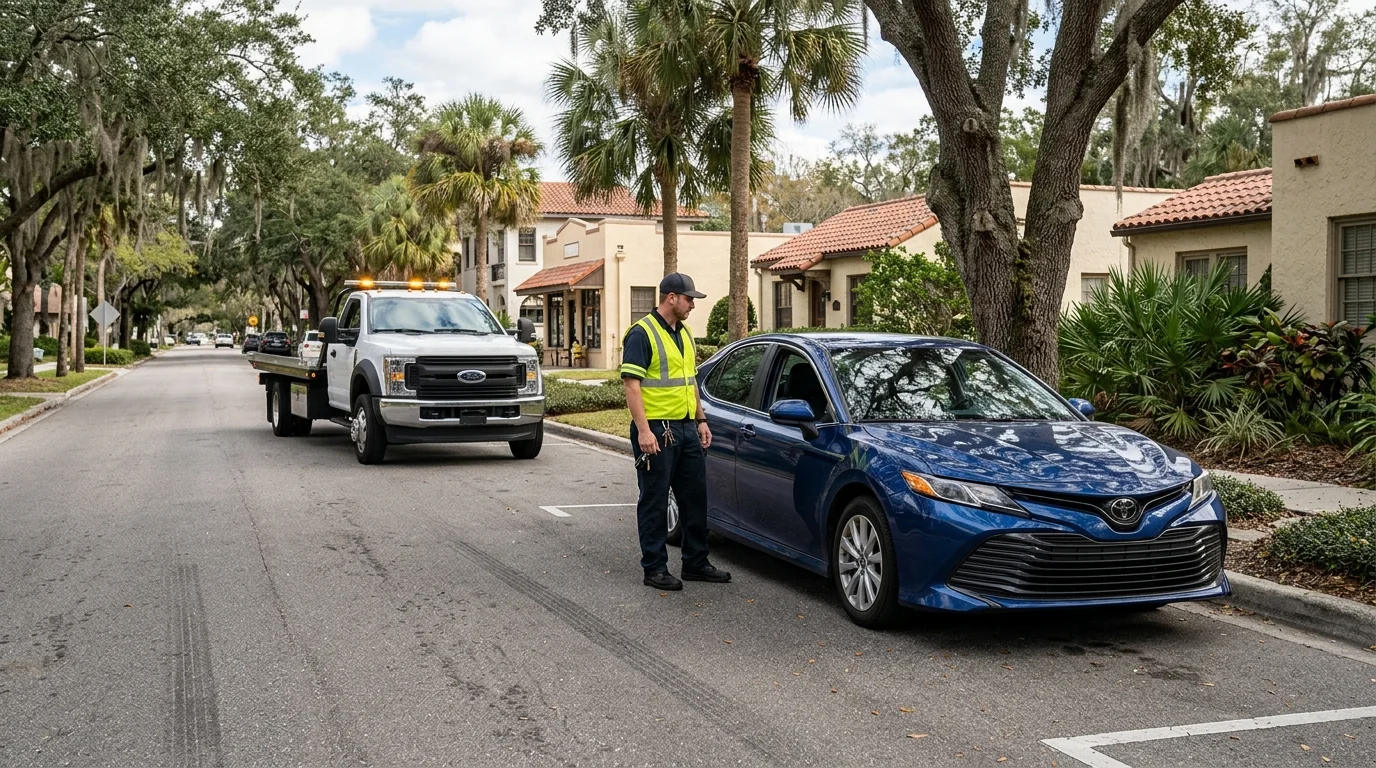
A car breakdown in Winter Park calls for two quick decisions. First, get away from moving traffic. Then decide whether the car needs roadside help or a tow.
Your next steps depend on where the car stopped. A shoulder near I-4 presents different risks than a parking space along Fairbanks Avenue. Start with safety, then work through the vehicle problem.
Move away from traffic before checking the car
Turn on the hazard lights as soon as the car loses power. Keep steering toward a safe stopping place while the vehicle still moves. A parking lot, side street, or marked parking space is usually preferable to a travel lane.
If you’re already stopped, look at the traffic around you. Don’t step outside until you can do so safely. Standing between your car and moving vehicles creates another hazard. Stay inside with your seat belt fastened when leaving would expose you to traffic.
Call 911 when the breakdown creates an immediate danger. That includes a vehicle blocking an active lane, visible fire, injuries, or another urgent threat. Give your direction of travel and the nearest road or crossing.
A breakdown near I-4 needs extra caution. Don’t attempt a repair beside fast-moving traffic when you can’t create safe working space. Our guide on what to do after breaking down on I-4 covers that setting in more detail. You can also review FL511 traffic and incident alerts before choosing a route or destination.
On US 17-92, Fairbanks Avenue, or another Winter Park street, avoid stopping around a blind turn. If the car can move safely, get fully clear of the travel lane. Don’t keep driving if steering, braking, overheating, or damaged tires make control uncertain.
Once safely stopped, turn off the engine. Take a moment before opening the hood. Smoke, leaking fluid, burning smells, and damaged electrical parts are reasons to leave the diagnosis to a professional.
Decide whether roadside help is enough
Not every breakdown needs a tow truck. A simple problem may be handled through roadside assistance in Winter Park. The right choice depends on the symptom, the vehicle’s location, and whether a safe repair is possible there.
Roadside help may fit when the problem is limited to:
- A drained battery
- A locked vehicle
- An empty fuel tank
- A damaged tire with a usable spare
- Another minor issue that doesn’t require a repair shop
Don’t assume a jump-start solves every no-start condition. Clicking, smoke, repeated stalling, or warning messages may point to a different problem. Stop trying to restart the car if each attempt produces new sounds or smells.
A tow is usually the safer choice when the vehicle can’t roll normally. The same applies when steering or braking feels unreliable. Overheating, collision damage, fluid loss, or multiple flat tires also make roadside repair less practical.
Location matters too. A tire change in a quiet parking area differs from one beside I-4. Even a manageable problem may require towing when there’s no safe space for roadside work.
Tell the operator what happened before the vehicle stopped. Mention warning lights, noises, smoke, leaks, impact damage, and unsuccessful repair attempts. That information helps determine whether to arrange roadside service or emergency towing.
Don’t crawl under the car beside an open road. Avoid touching leaking fluid or damaged wiring. If you can’t identify the problem without entering traffic or handling damaged parts, wait somewhere safer.
Describe your Winter Park location clearly
A precise location prevents confusion. “Somewhere in Winter Park” doesn’t tell an operator which entrance, shoulder, or parking area to use. Start with the road name and your direction of travel.
For a car stopped near US 17-92, say whether you’re traveling north or south. On Fairbanks Avenue, include your direction and the nearest cross street you can confirm. If you’re near I-4, provide the highway direction and the exit or mile marker shown nearby.
Your phone’s map pin can help, but add visible access details. A pin may land on the wrong side of a divided road. It may also identify a building without showing the correct driveway.
Share details such as:
- The road and travel direction
- The nearest confirmed intersection
- Which side of the street you’re on
- A business or building name you can read
- The parking lot entrance closest to the car
- A garage level, row, or space number
- Whether a gate limits vehicle access
Describe the vehicle too. Give its color, make, model, and body style. Turn on the hazard lights if they work. Don’t stand in traffic to wave down the arriving operator.
If the car is inside a garage, mention clearance and turning space. A garage entrance that accepts passenger cars may not suit every tow vehicle. Tell the operator about ramps, low ceilings, tight corners, or access controls before dispatch.
Check the pin before sending it. Zoom in and confirm that it matches the car’s actual side of the road. A clear location description matters more than a nearby address that leads somewhere else.
Share the vehicle condition before dispatch
The operator needs more than “the car won’t move.” Explain what the vehicle can and can’t do. Those details help the network match the breakdown with suitable service.
Start with the basics. Does the engine start? Can the transmission shift into neutral? Do the wheels roll? Is the steering unlocked? Are any tires flat, missing, or turned against a curb?
Then describe anything unusual:
- The car sits lower on one side
- A wheel looks bent or displaced
- Fluid appears beneath the vehicle
- The bumper or underbody touches the ground
- The keys are locked inside
- The battery has no power
- The parking brake won’t release
- The vehicle entered a ditch, median, or soft ground
Mention whether the vehicle is electric, hybrid, all-wheel drive, or heavily modified. Also identify motorcycles, vans, trucks, or vehicles carrying trailers. Different vehicle conditions can change the equipment and loading approach.
Don’t move damaged pieces simply to make the car look ready. Loose body panels and broken suspension parts can shift during loading. Keep people and belongings clear while the operator inspects the vehicle.
If another vehicle struck yours, explain where the damage appears. Say whether airbags deployed or broken glass surrounds the car. Don’t claim the vehicle is safe to drive because it still starts. Steering, brakes, tires, and cooling components may have damage you can’t see.
Photos can help when requested. Take them only from a safe position. Don’t walk into a lane or stand behind the disabled car to capture a better angle. Clear, honest details are more useful than guessing at the mechanical cause.
Choose a destination that can receive the car
Pick the destination before the tow truck arrives when possible. The best destination may be a repair shop, dealership, tire shop, home, or another lawful parking location. The choice should match the likely problem and the property’s access rules.
Call the destination first. Confirm that it accepts disabled vehicles and can receive yours when it arrives. Ask where the vehicle should be placed if the service desk is closed. Don’t assume an open parking space means overnight drop-off is permitted.
Give the receiving location’s full address to the operator. Include the business name and any confirmed entrance instructions. If the property has several driveways, explain which one reaches the service area.
Think about the suspected repair. A tire shop may fit a damaged tire, while an electrical or cooling problem may need a general repair facility. A dealership may make sense when the vehicle requires brand-specific service. You don’t need to diagnose the failure yourself. You only need a destination prepared to evaluate it.
Remove medications, identification, house keys, work equipment, and other essentials before transport. Keep the vehicle key available unless the receiving facility has provided another plan. Don’t leave loose valuables visible inside.
If you haven’t chosen a shop, say so during the call. You can discuss the destination before the truck rolls. For breakdowns outside ordinary business hours, our guide to after-hours towing in Orlando explains how to prepare for the call and an after-hours drop-off.
When to call us
Call when your vehicle can’t move safely, roadside service won’t solve the problem, or the location makes self-help risky. Quick Tow Orlando takes calls at any hour, dispatches Monday to Friday from 8 a.m. to 10 p.m., and connects drivers with independent towing and roadside operators across the Orlando Metro. Call us at (321) 321-9797.