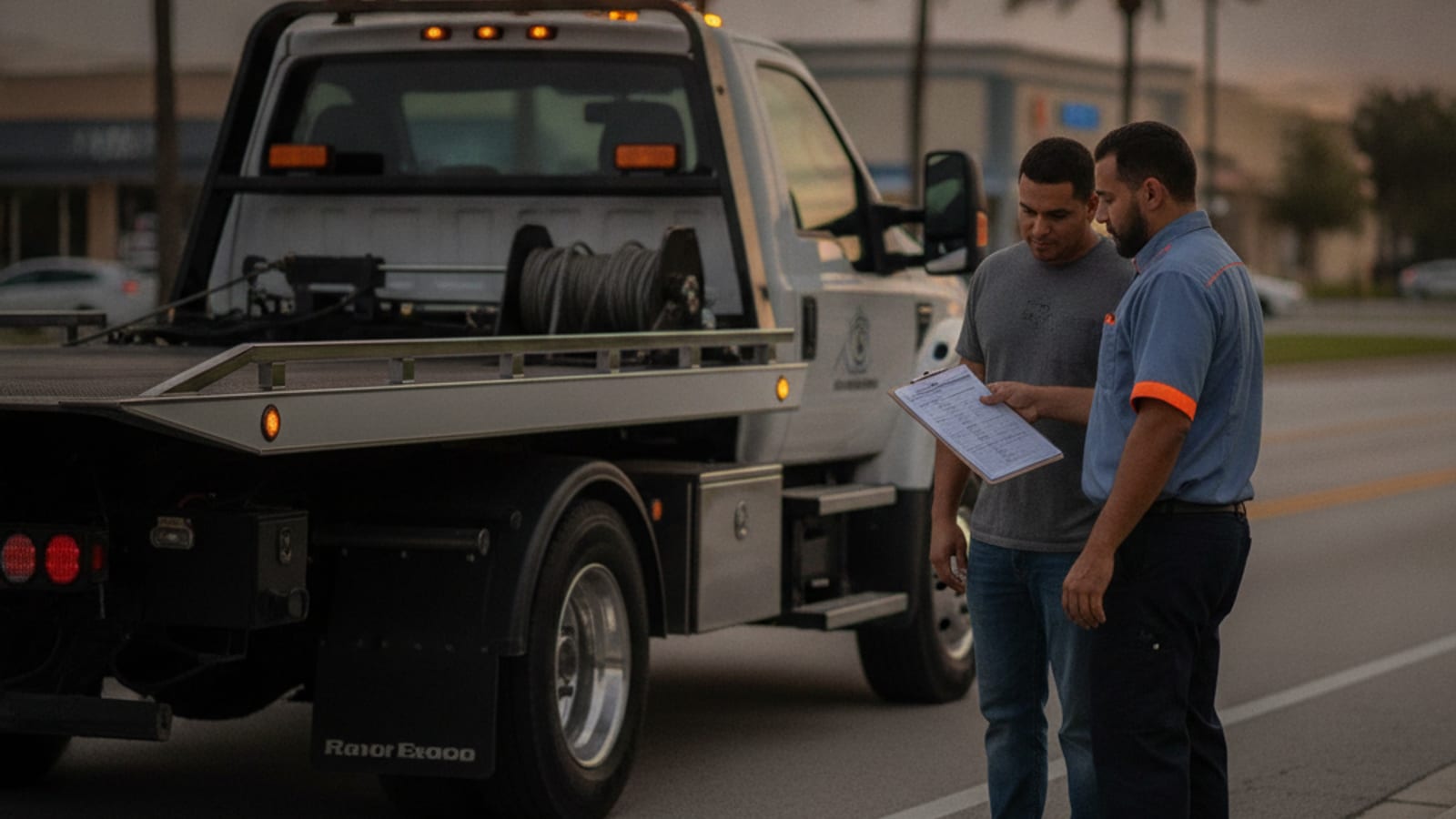
Yes, but only partly, and where you were towed changes the answer. Florida Statute 715.07 covers private property towing signage and notice, and it sets no dollar figure at all. The mandatory rate-setting command is Florida Statute 125.0103(1)(c), which makes every county publish maximum towing and storage rates. Florida Statute 166.043(1)(c) then lets a city displace those rates inside its own limits. City of Orlando dollar caps are not restated here because they were not independently verified for this article. Orange County’s Chapter 35 governs unincorporated county for trespass and nonconsensual tows. Neither schedule applies to a tow you called yourself.
Who actually sets towing rates in Florida
Florida doesn’t run one statewide towing rulebook. There’s no such thing as a Florida towing license, the way the state licenses electricians or contractors. Regulation here comes from two different places.
Florida Statute 715.07 governs private property towing. It sets rules for signage, for how much warning a driver gets, and for when a car can be removed at all. It also lets a driveway or business owner have a blocking car removed without a posted sign in some cases, like a vehicle parked across a driveway entrance. But the statute sets no dollar caps of its own. It hands rate regulation to counties and municipalities instead.
The other piece is Florida Statute 713.78, the lien law. It governs how a tow company can legally hold, then eventually sell, a car nobody claims. Between those two statutes, that’s the entire state-level framework. Everything else, including the number on your bill, comes from local ordinance.
Two schedules, and which one applies depends on where you were towed
Orange County’s caps are not the whole picture in this metro. Florida Statute 125.0103(1)(c) requires every county to set maximum towing and storage rates, and Florida Statute 166.043(1)(c) then says that where a municipality enacts its own maximum rates, the county’s ordinance does not apply inside that municipality.
The City of Orlando has enacted its own code for tows that start inside city limits, under Florida Statute 166.043(1)(c). Specific city dollar figures are not listed in this article because they were not independently verified for this pass. If your pickup started inside city limits, read the city’s current code rather than assuming the county table applies.
For unincorporated Orange County, Chapter 35 is the verified schedule used below.
Orange County’s answer: chapter 35
For unincorporated Orange County, that local ordinance is Chapter 35, most recently amended by Ordinance No. 2023-10, effective April 1, 2023. It sets maximum rates for two specific kinds of tows: a trespass tow, meaning a car removed from private property without the owner’s consent, and a nonconsensual tow, meaning a car removed without the owner’s consent at an accident or incapacitation scene. These are county maximums. No company operating under the ordinance can legally charge more.
The caps scale with vehicle weight, split into four classes.
| Class | Trespass tow (flat) | Nonconsensual tow | Storage (per day) |
|---|---|---|---|
| A (passenger vehicles up to 10,000 lbs) | $135 | $135 flat + $4.00/mile | $32 |
| B | $250 | $315 flat | $44 |
| C | $375 | $400 flat | $76 |
| D | $500 | $550 flat | $76 |
Storage accrues in 24-hour blocks, not by the calendar day, and it doesn’t start immediately. A trespass tow gets a 24-hour free period before storage starts. A nonconsensual tow gets six hours. After that, the daily rate above applies.
What else the ordinance caps
The rate table isn’t the whole story. Chapter 35 caps several other line items that show up on a real bill.
A drop fee applies if you get your car back after the driver hooks up but before the truck leaves. The county caps it at half the class’s flat rate, so a Class A drop fee tops out at $67.50, and the operator has to wait at least 15 minutes on scene to give you the chance.
A dolly fee, used on some nonconsensual Class A tows, is capped at $40. Beyond that, the ordinance bars a long list of other equipment line items outright. No separate charge for a lockout entry, a gate or after-hours fee, fuel, a slim jim, or copies of the statute. If it’s not on the approved list, it can’t be on your bill.
An administrative fee of $50 is only allowed after the first 48 hours of paid storage, meaning the free period doesn’t count toward it, and only if the company followed the lien-notice process required under Florida Statute 713.78. A tarp fee, charged when a vehicle reasonably needs to be covered, is capped at $15, one time. If your registration is expired, the company can charge actual research cost up to $7 to look you up, nothing more.
Payment terms are capped too. The ordinance requires tow companies to accept cash, money order, cashier’s check, and major debit or credit cards, and it bars any surcharge for using a card. Cash payments round to your benefit, not theirs.
What these caps don’t cover
Notice what both rate categories are named for: a trespass tow and a nonconsensual tow. Both mean someone else had your car removed, a property manager, an HOA, or a police officer at the scene of a crash.
None of that applies to a tow you call yourself. If you break down on I-4, lock your keys in the car, or just need a vehicle moved across town, you’re the customer choosing the company. That’s a consensual tow, and none of the caps above reach it. The price is set by the open market, the same way a locksmith or a plumber quotes a job.
That’s exactly why you should get the total over the phone before an independent operator is matched. There’s no county number that sets the price on a tow you call, so the protection that matters is a number you agree to before anyone rolls. For how a consensual tow is priced in this market, see how much does a tow cost in Orlando, or run your own trip through our Orlando towing cost guide.
If you think you were overcharged
If a trespass or nonconsensual tow bill runs over the county caps, or you think the tow itself was wrong, Orange County Consumer Protection takes complaints at (407) 836-3111. You can also ask a lawyer about posting a bond in circuit court instead of paying a disputed bill.
If your car is already sitting in a storage yard, start with the number on the tow-away sign. For consensual-tow pricing in this market, see how much does a tow cost in Orlando.
Get the total before anyone rolls
None of the rate caps above set the price on a tow you call, because a consensual tow is exempt from both schedules. Quick Tow Orlando connects callers with independent operators. Tell us where you are and what you’re driving. We pass that to a local operator, who is responsible for capability, timing, price, and terms. Call (321) 321-9797.
Frequently asked questions
Is there a maximum towing fee in Florida?
Not a statewide one. Florida law delegates rate-setting to local government under FS 125.0103(1)(c). In unincorporated Orange County, Chapter 35 caps a trespass tow on a standard passenger vehicle at $135 flat. Inside city limits, check that city’s current code rather than a dollar figure that was not verified for this article.
Do towing companies need a license in Florida?
No. Florida doesn’t issue a statewide towing operator license. Regulation comes from the state lien statute, Florida Statute 713.78, combined with local ordinances like Orange County’s Chapter 35.
Can a tow company charge extra fees in unincorporated Orange County?
Only the ones Chapter 35 allows. A dolly fee is capped at $40, an administrative fee at $50 after the first 48 hours of paid storage, and a tarp fee at $15. Charges like a lockout fee, a gate fee, or a fuel surcharge are barred outright. Those dollar caps are county figures. They are not City of Orlando rates.
Does the county rate cap apply if I call a tow truck myself?
No. The caps in Chapter 35 apply to trespass tows and nonconsensual tows, meaning someone else had your car removed. A tow you call yourself is a consensual tow, priced by the operator you choose, which is why you should get the total before that operator is matched.
Can a tow company charge extra for paying with a credit card?
No. Orange County’s ordinance bars any card surcharge, and it requires companies to accept cash, money order, cashier’s check, and major debit or credit cards. Cash payments round to the customer’s benefit.
What can I do if I think I was overcharged on a tow?
Contact Orange County Consumer Protection at (407) 836-3111. You can also ask a lawyer about posting a bond in circuit court instead of paying a disputed bill.