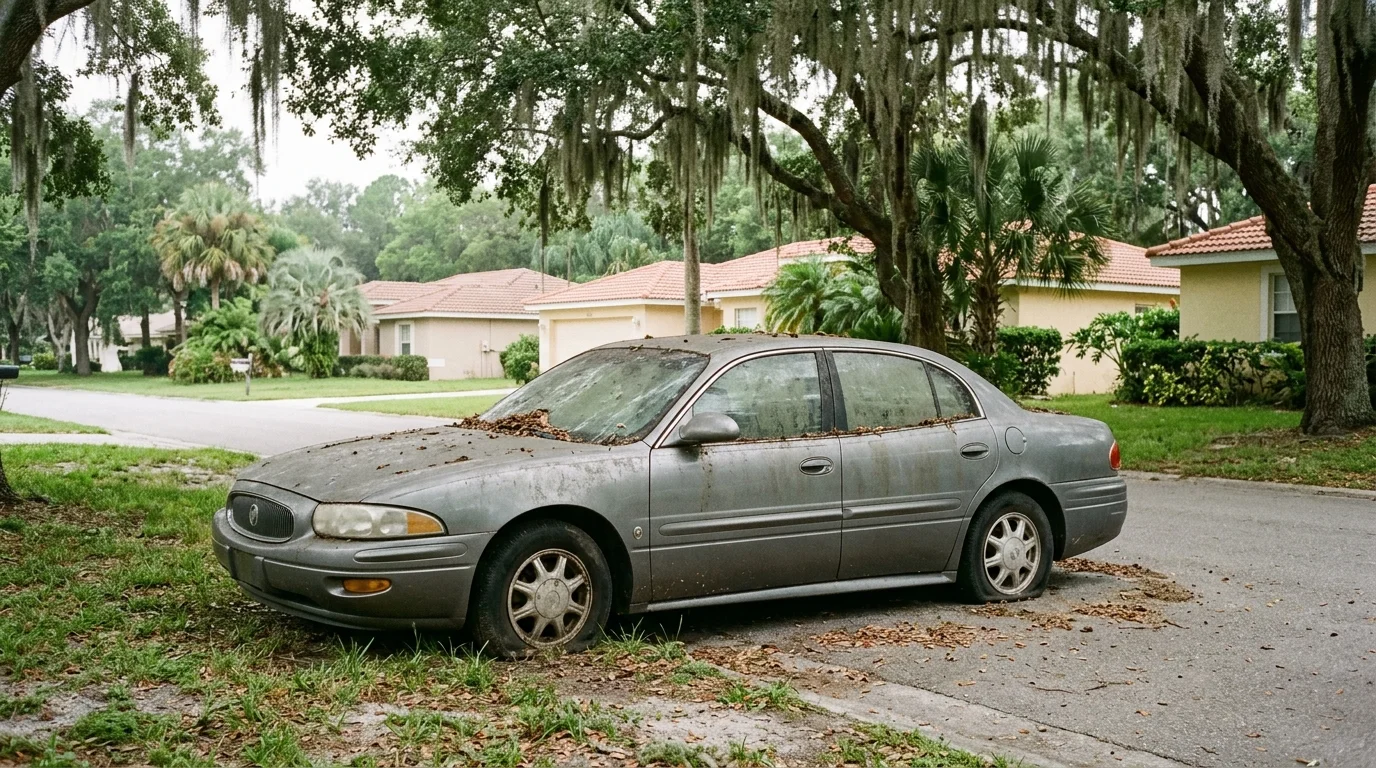
If you need an abandoned vehicle removal service in Orlando, first identify where the vehicle sits. A car on a public right-of-way must be reported to law enforcement. A vehicle on private property follows a different process, while your own unwanted car may be handled as a consensual removal.
That distinction decides who can authorize the tow. It also determines which notice and custody rules apply.
Three different problems people call abandoned vehicle removal
“Abandoned vehicle” describes several situations that look similar but aren’t legally identical.
The first is a vehicle left on a public road or right-of-way. Picture a dusty sedan near an Orlando neighborhood street, with flat tires and leaves across its windshield. Florida Statute 316.194 provides the removal rule for that situation. A police officer or traffic accident investigation officer orders the removal.
The second is someone else’s vehicle left on private property. It may be sitting behind a business near International Drive, inside an apartment lot, or across a private driveway. That situation generally falls under Florida’s private-property towing rules. The party controlling the property shouldn’t treat it as a public-road abandonment case.
The third is a vehicle you own and no longer want. It might be damaged, inoperative, or taking up space after hurricane-season flooding. That usually isn’t an enforcement matter. You may need a tow operator, a salvage buyer, and the correct ownership documents. Our guide to paperwork for junking a car in Florida explains the title and plate issues.
Start by answering three points:
- Is the vehicle on public or private land?
- Do you own it?
- Is it blocking access or creating an immediate road hazard?
Don’t move, enter, sell, or dismantle a vehicle you don’t own. Record its location and condition instead. Then contact the party authorized to handle that setting.
Quick Tow Orlando can connect callers with a local operator for eligible private jobs. We can’t declare a vehicle legally abandoned or authorize its removal from public land.
On a public road: forty-eight hours, and thirty feet
Florida Statute 316.194 supplies the specific public-right-of-way timeline. It applies based on both time and distance from the pavement.
A vehicle parked or stored on the public right-of-way for more than 48 hours may be removed when it sits within 30 feet of the pavement edge. When the vehicle is more than 30 feet from that edge, the waiting period is 10 days.
Those periods don’t give a private caller authority to order the tow. The statute says a police officer or traffic accident investigation officer may order removal. The vehicle goes to the nearest garage or another place of safety. Removal costs become a lien against the vehicle.
Florida Statute 705.102 also says a person who finds abandoned property must report its description and location to a law enforcement officer. That section doesn’t state a deadline for the person making the report.
Use the official website for the agency serving the exact location. A shoulder near SR 408 may involve a different reporting channel than a residential street or an unincorporated Orange County road. For unincorporated Orange County, look up the county’s current code-enforcement contact on its official website. We couldn’t confirm a current address or phone number from the approved sources for this guide.
Give the agency an exact location, including the road name and nearest cross street. Describe whether the vehicle blocks a lane, driveway, sidewalk, or sight line. Don’t assume that visible damage shortens the statutory period.
If a car blocks your driveway from the public right-of-way, Florida law provides a separate exception to the usual sign requirement. Our guide to a car blocking your driveway in Orlando explains that route.
The statute everyone cites that does not say it
Many online summaries point readers to Florida Statute 705.101 for the 48-hour rule. That citation is wrong.
Section 705.101 doesn’t define an “abandoned motor vehicle.” It defines abandoned property more generally. The definition covers tangible personal property disposed on public property in a wrecked, inoperative, or partially dismantled condition. The section contains no 48-hour vehicle-removal period.
The public-road timing comes from Florida Statute 316.194. That is where Florida places the 48-hour, 30-foot, and 10-day rules.
This difference matters because the statutes do separate jobs. Section 316.194 addresses when a vehicle on a public right-of-way may be removed. Chapter 705 contains broader rules for abandoned or lost property after authorities take custody.
Another common mistake involves a 21-day removal window found in Chapter 705. That period is vessel-specific. It shouldn’t be applied to cars, pickup trucks, motorcycles, or other road vehicles.
A second 30-day figure causes similar confusion. Florida Statute 323.001 concerns certain investigatory or evidentiary holds at a wrecker facility. If such a hold continues, the investigating agency must take possession within 30 days of the first storage day unless another timeframe is agreed in writing. It doesn’t mean every abandoned car can sit for 30 days.
When reporting a vehicle, describe what you see instead of declaring which statute controls. Its location, ownership, condition, and reason for custody determine the next step. The receiving agency can decide whether the public-road rule, a Chapter 705 process, or another authority applies.
On your own property, the order of operations is different
A car left in a private parking lot isn’t automatically covered by the public-road timeline. Florida Statute 715.07 governs private-property towing, including required notice in many situations.
The party controlling the property should first confirm that the vehicle sits within the property boundary. A grass strip, access lane, or shoulder may appear private while belonging to a public right-of-way. When the boundary isn’t clear, check the parcel record or ask the appropriate local office before arranging removal.
Next, determine whether the vehicle belongs to a tenant, customer, guest, contractor, or unknown person. Existing parking terms and tow-away signs may affect the available route. Review our guide to private-property towing before authorizing an operator.
The full sign standards appear in Florida Statute 715.07. Don’t rely on a handwritten note or an old sign from another property.
Florida law includes narrow exceptions. A vehicle on a public right-of-way may be removed without a posted tow-away sign when it blocks access to a private driveway. The statute also addresses vehicles positioned so they restrict normal business operations. These exceptions don’t turn every unwanted parked car into an immediate tow.
Photographs can preserve the vehicle’s position and visible condition. Written notes can also record when it was first observed. Those steps may help explain the request, but they don’t replace any required authorization or notice.
If you own the unwanted vehicle, the path is simpler. You can request junk car and abandoned vehicle removal as a consensual job. Have the title status checked before a salvage transaction. A salvage dealer generally needs a valid title, salvage certificate, certificate of destruction, or the applicable derelict motor vehicle paperwork.
Where the car goes, and the clock that starts
For a public-right-of-way removal under Florida Statute 316.194, the vehicle goes to the nearest garage or other place of safety. The removing agency must report the removal to Florida highway officials within 24 hours. You can confirm current vehicle and title guidance through FLHSMV.
The next timeline depends on how authorities took custody. When an officer takes abandoned property into custody under Chapter 705 and it can’t be easily removed on the spot, Florida Statute 705.103 calls for posted notice giving five days to claim it. A known owner or lienholder receives notice by certified mail, return receipt requested.
The general lost-property process then uses a 90-day retention period. Publication occurs within the first 45 days. A sale can’t take place sooner than 10 days after final publication.
That sequence isn’t the same as an unclaimed private-property tow. A trespass-towed vehicle follows Florida Statute 713.78 and its lien process. The lien-sale clock is 35 days for a vehicle more than three model years old. It is 57 days for a vehicle three model years old or newer. Certified-mail notice goes to the owner, insurer, and lienholders within five business days. Public notice must appear on an approved website at least 20 days before sale.
An investigatory hold is another separate track. It may involve evidence, a fatal-crash investigation, contraband forfeiture, a qualifying impound, or a court order. The agency’s possession deadline under Florida Statute 323.001 shouldn’t be confused with either lien-sale schedule.
If you’re trying to find a removed vehicle, start with the agency that ordered the tow. Ask where it was taken and which custody process applies. Don’t assume the closest visible tow yard received it.
For private-property removals in Orange County, the county’s official towing information page explains how to locate a towed vehicle. Its Chapter 35 information isn’t a substitute for the City of Orlando’s Chapter 39 rules when a tow originated inside Orlando city limits.
When to call us
If you own the vehicle, or control the property and have confirmed the correct removal path, call an operator instead of trying to roll or pull the car yourself. For a vehicle on a public right-of-way, start with law enforcement, but Dispatch runs Monday to Friday, 8 a.m. to 10 p.m., and we can match eligible private jobs with a local operator. Call us at (321) 321-9797.