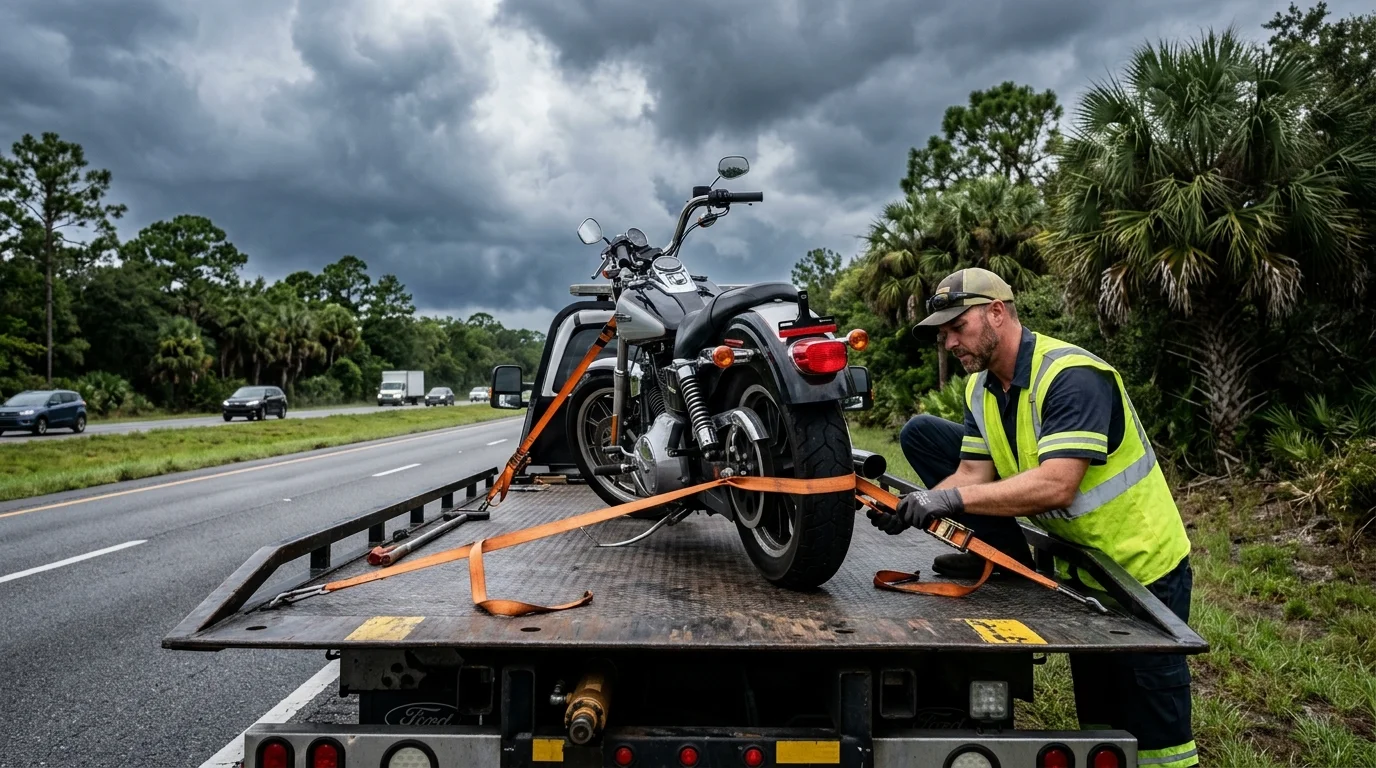
Before you book a motorcycle towing service in Orlando, get the loading plan first. Ask how the bike will stay upright, what will touch it, and how locked steering will be handled. Those answers matter beside I-4, along SR 50, or in a rain-soaked parking lot.
Why a motorcycle needs its own loading plan
A motorcycle needs a plan built around its condition and shape. The operator needs more than your location and destination. Describe the bike before anyone accepts the job.
Start with the motorcycle type. Say whether it’s a cruiser, sport bike, touring bike, scooter, or another style. Mention fairings, saddlebags, a windshield, a low exhaust, or other exposed parts. You don’t need technical measurements unless the operator requests them.
Next, explain what the motorcycle can still do. Does it roll freely? Can the handlebars turn? Is the steering locked? Will it shift into neutral? Has a wheel, brake, control, or stand been damaged? Clear answers help the operator plan before reaching the bike.
Location also changes the conversation. A motorcycle beside I-4 presents a different setting than one inside a Winter Park garage. Mention parking-garage clearance, gates, soft ground, tight turns, curbs, or limited access. If you’re near SR 408, SR 417, or the Turnpike, give your direction of travel and the safest identifiable location.
Ask whether the operator regularly handles motorcycles. Then ask what transport approach is planned for your specific bike. Our motorcycle towing service page explains how we connect riders with local operators. If a flatbed towing option is proposed, confirm how the bike will be loaded and kept upright.
Don’t try to solve the job with a rope or improvised setup. A roadside breakdown isn’t the place to test a homemade towing method.
Ask how the bike will stay upright
“Will the motorcycle stay upright during loading and transport?” is the first question to ask. Follow it with another: “What parts of the bike will your securement touch?”
The operator should be able to explain the planned contact areas. Listen for a bike-specific answer, not a generic statement about towing vehicles. Point out painted panels, fairings, mirrors, cables, brake lines, exhaust parts, and accessories that must remain clear.
You don’t need to prescribe a strap count or equipment rating. Those details depend on the motorcycle and the operator’s setup. Focus on the outcome. Nothing should press against a delicate panel or depend on a loose accessory.
Ask how the wheels will be managed during transport. If a tire is flat, a wheel is bent, or a brake won’t release, say so before loading starts. The operator may need to adjust the plan or decide whether the available setup fits the job.
Summer rain can interrupt a roadside handoff quickly. Share the motorcycle’s condition by phone when possible. That gives the operator time to consider the job before equipment is positioned.
Keep your own position in mind too. Don’t stand between the motorcycle and moving traffic. The state’s Move Over requirements cover tow trucks displaying amber lights. Still, that protection doesn’t make an I-4 shoulder a good meeting room. Save detailed discussion for a safer spot whenever possible.
Before the bike moves, ask the operator to walk you through the final plan. A short explanation can expose a misunderstood condition or vulnerable part.
Point out existing damage before loading
Document the motorcycle’s condition before loading, when the location is safe. Take clear photos from the front, rear, and both sides. Add closer photos of any existing scratches, cracks, dents, bent controls, or loose accessories.
Photograph the wheel areas, fairings, fuel tank, mirrors, exhaust, and luggage. Include the area that appears to have caused the breakdown. If the bike was involved in a crash, don’t move loose pieces simply for a better photo.
Roadside safety comes first. Don’t step toward traffic or crouch beside an exposed lane. If you can’t photograph one side safely, tell the operator and document it later.
Point out existing damage directly. Don’t assume it’s obvious in rain, darkness, or roadside glare. A dark scuff can disappear against wet bodywork. A loose saddlebag may look secure until loading begins.
Ask the operator to acknowledge the condition you identified. This isn’t an accusation. It creates a shared starting point before the bike changes hands. Keep the original photos and any messages about the motorcycle’s condition.
The same approach matters with unusual finishes and hard-to-replace trim. Our guide to classic car towing in Orlando covers a similar handoff mindset. The vehicle is different, but the useful habit remains the same: identify vulnerable areas before loading.
If another person owns the bike, send that person the condition photos. Confirm who can approve the tow and destination. That avoids confusion when the operator arrives and someone else controls the keys or repair decision.
Account for locked steering and missing keys
Tell the operator about locked steering or missing keys during the first call. Don’t wait until the motorcycle tow truck is beside the bike. Either issue may change how the motorcycle can be aligned and moved.
Be specific about the key situation. Is the key lost, broken, locked in storage, or held by someone elsewhere? If you have the key but the ignition won’t turn, say that instead. Those are different conditions.
Explain whether the handlebars move and whether the bike rolls. Mention a damaged ignition, jammed lock, deployed security device, stuck brake, or transmission that won’t shift into neutral. Don’t force the steering lock or ignition while waiting.
Ask this direct question: “Can you handle the bike in its current condition without forcing the steering or controls?” The operator can then accept the job, request more details, or explain another option.
Photos can help here too. Show the front wheel’s position, the handlebar angle, and the space around the motorcycle. A bike facing a wall inside a Lake Nona garage may present different access than one standing in an open Kissimmee lot.
Also report any fluid, damaged battery area, or loose bodywork you can see. Don’t touch an unknown leak. Simply describe its location and appearance so the operator can consider it.
Keep ownership and access details ready. The operator may need confirmation that the motorcycle can be released from the property. If it’s behind a gate, inside a garage, or controlled by a repair shop, contact the person who can provide access. Don’t promise access that you haven’t confirmed.
Confirm the destination and handoff
Give the operator a complete destination before the motorcycle moves. Confirm the street address, entrance, business name, and receiving contact. A dealership’s main address may not identify its service entrance.
Call the destination yourself. Ask whether it can receive the motorcycle when delivered. Confirm where the operator should leave it and who will accept the key. If nobody will be present, get clear instructions before approving the tow.
Don’t assume a shop will accept every motorcycle or every after-hours delivery. That specific policy must be confirmed with the receiving location. If the first destination declines, choose another before loading begins.
Repeat the destination aloud and send it in writing when possible. Orlando has similar street names, divided roads, and entrances reached from different directions. A written address gives everyone the same reference.
Ask what documentation will accompany the handoff. Confirm who will receive the motorcycle, keys, loose pieces, and any luggage staying with the bike. Remove personal items that aren’t needed at the destination, if you can do so safely.
Discuss charges directly with the operator before approving the job. Quick Tow Orlando doesn’t publish a towing rate card. Ask which towing or storage charges apply and when they begin. Our guide to tow cost questions in Orlando explains what to clarify before payment.
We couldn’t confirm current City of Orlando or Orange County maximum rate schedules from the approved primary-source research. If a rate rule matters, request the current schedule from the operator. Then verify it with the government office responsible for the tow’s origin.
Finally, decide who gets the completion update. It may be you, the motorcycle’s owner, or the receiving shop. Confirm that person’s name before the operator leaves with the bike.
When to call us
Call when the motorcycle can’t be ridden safely, has locked steering, lacks a key, or needs a planned handoff. The Quick Tow Orlando line takes calls at any hour, dispatches Monday to Friday from 8 a.m. to 10 p.m., and connects you with a local tow operator who can assess the job. Call us at (321) 321-9797.