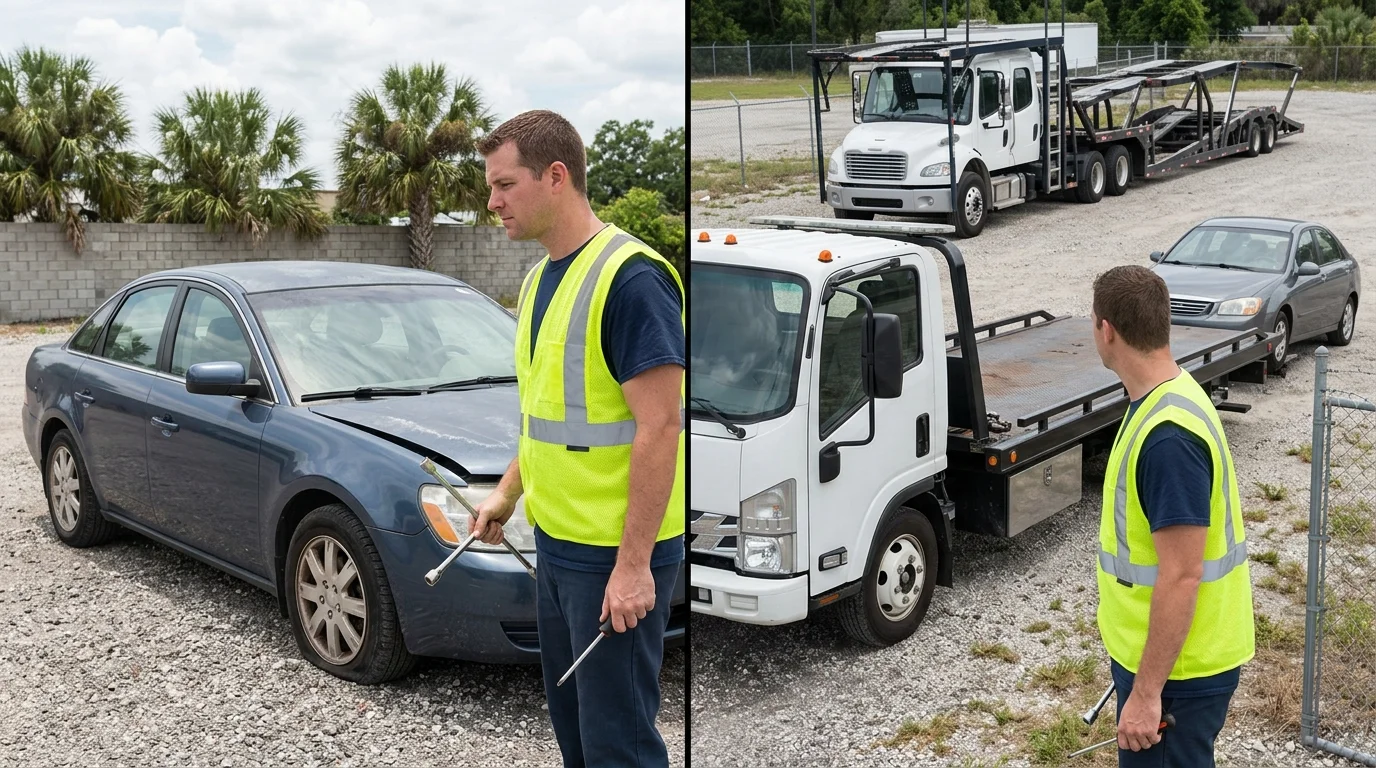
A car that won’t run in Orlando can leave you choosing between a direct tow and scheduled transport. The better fit depends on the route, loading condition, access, and timing. To decide whether to tow or ship a non-running car, start with what the vehicle can do and what both addresses allow.
Start with the distance and vehicle condition
Distance matters, but it doesn’t settle the decision alone. A direct tow may fit a defined trip from one Orlando address to another city. Scheduled transport may fit a flexible move with less urgency. Neither choice is automatically right for every non-running vehicle.
Start by describing the vehicle accurately. “Non-running” can mean several things. The engine may not start, while the wheels, steering, and brakes still work. Another car may have locked steering, flat tires, collision damage, missing keys, or a wheel that won’t turn. Those differences affect loading more than the vehicle’s age or appearance.
Tell the provider:
- Where the vehicle sits now
- Where it needs to go
- Whether it starts, rolls, steers, and brakes
- Whether every tire holds air
- Whether the keys are available
- Whether the vehicle has visible collision or suspension damage
- Whether loose parts or personal property remain inside
Use exact pickup and delivery addresses when requesting a written quote. A move from Lake Nona to Winter Park presents different planning needs than a trip leaving Central Florida by I-4 or Florida’s Turnpike. The operator also needs to understand where the vehicle sits at each address.
If the destination is outside the Orlando area, review the questions in our long-distance towing guide. For budgeting factors, the Orlando long-distance tow cost guide explains what to clarify without assuming one standard rate.
Don’t hide damage because you’re worried about the quote changing. An accurate condition report helps the provider decide whether the job matches its equipment and loading process.
Compare direct towing with scheduled transport
Direct towing generally means arranging a tow operator for the full requested trip. Scheduled vehicle transport usually involves booking pickup around a carrier’s route and operating schedule. Confirm the exact process because providers may use those terms differently.
A direct tow may make sense when the destination expects the vehicle on a specific date. It may also suit a shorter regional move or a car that needs careful loading at a difficult location. Ask whether the same operator and equipment will handle the entire trip. Don’t assume there won’t be a transfer or storage stop.
Scheduled transport may suit an owner with more timing flexibility. Before booking, confirm that the provider accepts non-running vehicles. Some quotes may be based on a vehicle that can move under its own power. State the condition before accepting any agreement.
Use these decision points:
| Consideration | Direct towing | Scheduled transport |
|---|---|---|
| Timing | Ask whether pickup can match your required date | Ask how the pickup window is set |
| Vehicle condition | Explain all loading limitations | Confirm non-running service is included |
| Route | Confirm the full origin-to-destination scope | Ask whether the vehicle changes equipment or locations |
| Communication | Get the operator’s contact process | Ask who provides pickup and delivery updates |
| Payment | Request the full written charge structure | Request every possible added charge in writing |
For a long-distance tow or car shipping decision, compare the complete scope rather than one headline quote. Ask what happens if the vehicle won’t roll when the operator arrives. Also ask whether waiting, special loading, storage, cancellation, or a failed pickup can change the charge.
If the vehicle has low clearance, damaged wheels, or special handling needs, discuss flatbed towing before booking. The provider can then explain whether that option fits the vehicle and route.
Check access at pickup and delivery
Access can determine whether the planned equipment reaches the car. Look at the Orlando pickup location before you book. A downtown parking garage, International Drive hotel lot, gated Lake Nona community, or narrow Winter Park driveway can each create different limits.
Start with the vehicle’s exact position. Note whether it’s in a garage, behind a gate, beside a loading dock, or blocked by another car. Tell the provider about clearance signs, tight turns, steep ramps, soft ground, parking controls, and locked entrances. If you can’t confirm a clearance measurement, say so. Don’t guess.
Photos help explain the setting. Take wide images showing the route from the street to the car. Add closer images of the wheels, bumpers, suspension, and visible damage. Avoid sending only a tight photo of the vehicle. The operator needs context around it.
Check the delivery address with the same care. A repair shop may have a preferred drop area. An apartment property may restrict large vehicles or after-hours entry. A residential destination may lack enough open curb or driveway space. These aren’t reasons to abandon the move. They’re details to resolve before equipment arrives.
Contact the destination directly and ask:
- Where should the vehicle be placed?
- Will someone open a gate or garage?
- Are there equipment or clearance limits?
- Can a non-running vehicle remain there?
- Does the receiving location require advance notice?
- What should happen if the office is closed?
For a route using SR 408, SR 417, SR 429, I-4, or the Turnpike, provide the full address rather than naming the nearest exit. The final streets and property entrance often matter most during loading and delivery.
Confirm who can receive the vehicle
A successful move needs clear authority at both ends. Confirm who can release the car in Orlando and who can accept it at the destination. Get names and current contact details before the pickup date.
If you won’t attend pickup, ask the provider what authorization it requires. Don’t assume leaving keys inside is acceptable. Arrange a secure handoff with the person releasing the vehicle. If a repair shop, body shop, dealer, storage facility, or family member holds the car, make sure that party expects the operator.
The same rule applies at delivery. The receiving person should know the vehicle doesn’t run. They should also know about locked steering, damaged wheels, missing keys, fluid leaks, or parts stored inside. A destination prepared only for a running car may not be ready to position it after unloading.
Make a key plan. Confirm how many keys or fobs exist, which functions work, and who will transfer them. If no key is available, disclose that before booking. Don’t wait until pickup to mention it.
Remove valuables and document the car’s condition. Photograph each side, the interior, the wheels, and existing damage. Keep copies of the booking documents and condition notes. Ask how pickup and delivery condition records are handled.
Special-interest vehicles need another layer of planning. Our guide to classic car towing in Orlando covers clearance, condition records, and handling questions worth raising before the move.
Paperwork requests can vary by provider and destination. Ask what proof of ownership or authorization must be shown. For Florida title and registration questions, consult the FLHSMV vehicles, tags, and titles page rather than guessing what applies.
Ask for a written scope before booking
A written scope should describe the actual move you’re buying. It should match the vehicle, both addresses, access conditions, and timing discussed. If the document treats the car as operational, ask for a correction before agreeing.
The scope should identify:
- The pickup and delivery addresses
- The vehicle’s year, make, model, and identification details
- Its running, rolling, steering, braking, and tire condition
- Known damage or low-clearance concerns
- The planned transport method
- The expected pickup arrangement
- The delivery and acceptance process
- Who supplies the keys
- What the quoted charge includes
- Which conditions could change that charge
- Cancellation and rescheduling terms
- The process for documenting vehicle condition
- A contact method for pickup and delivery issues
Read exclusions closely. Ask direct questions about loading assistance, storage, transfers, inaccessible locations, and unsuccessful pickup attempts. The answer should appear in writing if it affects your decision.
Timing flexibility deserves special attention. Orlando travel can be affected by summer storms and Atlantic hurricane season, which runs from June 1 through November 30. Don’t rely on a verbal promise about a fixed arrival. Ask how weather, route changes, or access problems are communicated and handled under the agreement.
Before paying, confirm the business named on the document matches the provider handling the booking. Save the quote, agreement, payment record, photographs, and messages together. If another person manages either end, send that person the final instructions.
Quick Tow Orlando connects callers with local towing operators. When you contact us, describe the complete job instead of requesting only “car shipping.” That gives us a clearer basis for matching the request with an operator serving the route.
When to call us
Call a tow operator when the car can’t be safely driven, access needs planning, or the receiving location has specific instructions. Quick Tow Orlando can answer your call and connect you with a local operator for the requested route. Call us at (321) 321-9797.