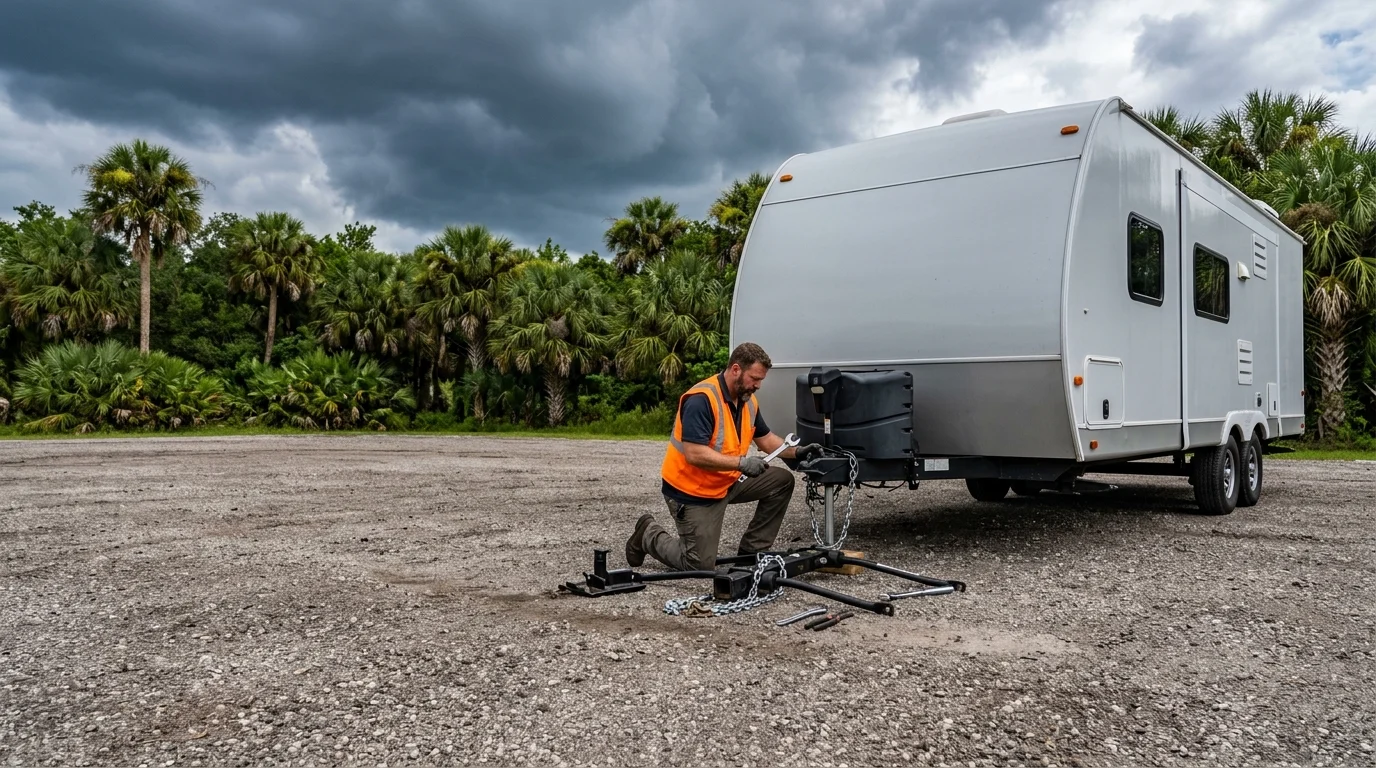
A tow operator may be able to move your trailer when your truck is unavailable. There isn’t one transport method for every trailer, though. If you need to tow a trailer without a tow vehicle, the operator must first assess the trailer, its condition, and both locations.
Start with the trailer type and location
Begin with the kind of trailer that needs moving. Tell the operator whether it’s a travel trailer, fifth wheel, pop-up camper, boat trailer, utility trailer, enclosed cargo trailer, or car hauler. If you aren’t sure what it’s called, send clear photos from several angles.
Next, explain whether the trailer is attached to anything. A disconnected trailer in a driveway differs from one coupled to a disabled truck. The operator also needs to know whether the trailer rests on its wheels, a tongue jack, landing gear, stabilizers, or another support.
Give an exact pickup location. A travel trailer beside I-4 creates different access concerns than one in a Kissimmee driveway or a Sanford storage lot. Mention whether it’s on a road shoulder, paved lot, grass, gravel, or soft ground. Include the direction of travel and nearest exit when you’re beside I-4, SR 408, SR 417, SR 429, or Florida’s Turnpike.
Traffic comes before trailer inspection. If you’re on a highway shoulder, don’t stand near an active lane to take photos. Check FL511 traffic and incident alerts when conditions around the location may be changing.
Florida’s Move Over law covers disabled vehicles displaying hazard lights and tow trucks displaying amber lights. Drivers on multilane highways must leave the closest lane when it’s safe. That rule doesn’t turn the shoulder into a safe inspection area.
For campers and recreational trailers, start with an RV and trailer towing request. The initial description helps Quick Tow Orlando connect you with an independent operator who can evaluate the job.
Explain what happened to the tow vehicle
The missing or disabled tow vehicle affects the whole request. Explain whether the truck broke down, was damaged, went to a repair facility, or simply isn’t available. Don’t shorten the story to “the trailer needs a tow.” The operator needs to understand what remains at the pickup point.
If the trailer is still attached, say so immediately. Tell the operator whether the truck can roll, steer, and shift normally. Mention visible collision damage, leaking fluid, a flat tire, or anything blocking access to the controls. Don’t start the truck or force a control that isn’t working.
Keys matter too. State whether you have keys for the truck, trailer compartments, hitch lock, coupler lock, and destination gate. If another person holds them, explain whether that person will meet the operator. Don’t promise access until you’ve confirmed it.
A disabled truck and attached trailer may require a different assessment than a trailer sitting alone. Let the operator decide whether the request involves the trailer, the tow vehicle, or both. Quick Tow can connect callers with emergency towing options when a disabled vehicle is also part of the problem.
If your camper failed during a trip, our guide to what to do when an RV breaks down covers the immediate roadside decisions. For a breakdown on Orlando’s busiest corridor, use the more location-specific guide for what to do after breaking down on I-4.
Be direct about anything you don’t know. “I don’t know whether the truck rolls” is more useful than a guess. The operator can then decide what must be checked at the scene.
Describe the hitch, wheels, and visible damage
Start with the hitch connection. Common descriptions include a ball coupler, fifth-wheel connection, pintle setup, or gooseneck connection. If those terms aren’t familiar, don’t guess. Send one photo showing the entire front of the trailer and another showing the connection closely.
Mention whether the coupler is open, locked, bent, or blocked. Include the tongue jack, landing gear, safety chains, wiring connector, and breakaway cable in the photos when they’re safely visible. Tell the operator about missing parts, but don’t crawl beneath the trailer to search for them.
Report the condition of every visible tire and wheel. Look from a safe position for flat tires, missing wheels, leaning wheels, damaged rims, or body panels touching a tire. Photograph both sides of the trailer when access allows. A trailer that appears level from one side may show obvious damage from the other.
Visible frame or suspension damage also belongs in the first call. Describe scraping, bending, loose material, or parts resting on the ground. If the trailer was involved in a collision, say where the impact occurred. Don’t attempt to straighten a hitch, raise damaged equipment, or test whether a wheel will turn.
Cargo changes the information the operator needs. State whether the trailer is empty or loaded. Describe the cargo in plain terms and mention anything that shifted, spilled, or may be unsecured. For a travel trailer, report whether steps, awnings, slide-outs, and exterior compartments are closed.
Don’t invent a trailer weight or equipment rating. If a manufacturer label is readable without entering traffic or climbing under the trailer, send a clear photo. The operator can determine which details matter for the transport assessment.
These observations aren’t a substitute for an onsite inspection. They help the operator avoid planning around an undamaged hitch or rolling trailer when the actual condition is different.
Check access at pickup and destination
A trailer may be movable but difficult to reach. Describe the full approach to the pickup point, not only the space beside the hitch. Mention gates, tight turns, slopes, soft ground, curbs, low branches, covered parking, and vehicles blocking the route.
Orlando-area locations vary widely. A gated property near International Drive may have a different approach than a Lake Nona driveway or rural lot outside Kissimmee. Give the operator the actual location and current conditions. Photos taken from the entrance toward the trailer can show access better than close-ups alone.
Confirm who controls the property. If the trailer sits behind a gate, identify the person who can open it. If it’s at an apartment, campground, storage property, repair facility, or commercial lot, confirm where the operator may enter and where the trailer may be collected.
Then check the destination with the same care. Confirm the correct address and the exact placement area. Ask the receiving property whether it will accept the trailer in its present condition. A repair facility may need specific arrival instructions, while a residence may have limited turning space.
Mention destination gates, surface conditions, slopes, trees, roof overhangs, and parked vehicles. Don’t assume a trailer can be left on a street, shoulder, or unapproved space. Get permission from the person responsible for that location before the move.
Central Florida weather can change surface conditions quickly. After a storm, update the operator about standing water, soft shoulders, fallen branches, or blocked entrances. A photo from earlier in the day may no longer represent the pickup area.
If the destination changes, tell the operator before transport begins. A new address may create different access concerns. The operator needs the real destination when choosing how to handle the trailer.
Let the operator choose the transport setup
There isn’t one correct setup for every disabled or disconnected trailer. Trailer design, hitch condition, wheel condition, cargo, damage, and site access all affect the operator’s decision. A method that fits one travel trailer may not fit another trailer parked beside it.
Avoid requesting a specific transport method based only on a photo, forum post, or past move. An intact-looking hitch may have damage that isn’t visible in a picture. A trailer that rolls several feet in a parking space may still need another plan for road transport.
Give the operator a complete summary:
- Trailer type and identifying photos
- Exact pickup and destination locations
- Whether the trailer is attached or disconnected
- What happened to the original tow vehicle
- Hitch, jack, wheel, and tire condition
- Known frame, body, or collision damage
- Whether the trailer is empty or loaded
- Keys, locks, gate codes, and property access
- Tight turns, slopes, soft ground, or overhead limits
Photos help, but they don’t make the final decision. The operator who evaluates the trailer must choose a setup compatible with the actual condition and access. Don’t connect the trailer to an unfamiliar vehicle or improvise around a damaged hitch while waiting.
Quick Tow Orlando refers these requests to independent towing and roadside operators. We don’t own tow trucks or perform the transport. We collect the job details and connect callers with an operator serving the Orlando Metro.
Before authorizing the move, confirm what the operator plans to transport. Ask whether the disabled truck is included, where the trailer will be placed, and what access is needed at delivery. If any part of the job changes, provide the new information instead of assuming the original setup still applies.
When to call us
Call a tow operator when the trailer is stranded, separated from its truck, attached to a disabled vehicle, or showing hitch or wheel damage. Quick Tow Orlando can connect you with an independent operator who can assess the trailer and location. Call us at (321) 321-9797.