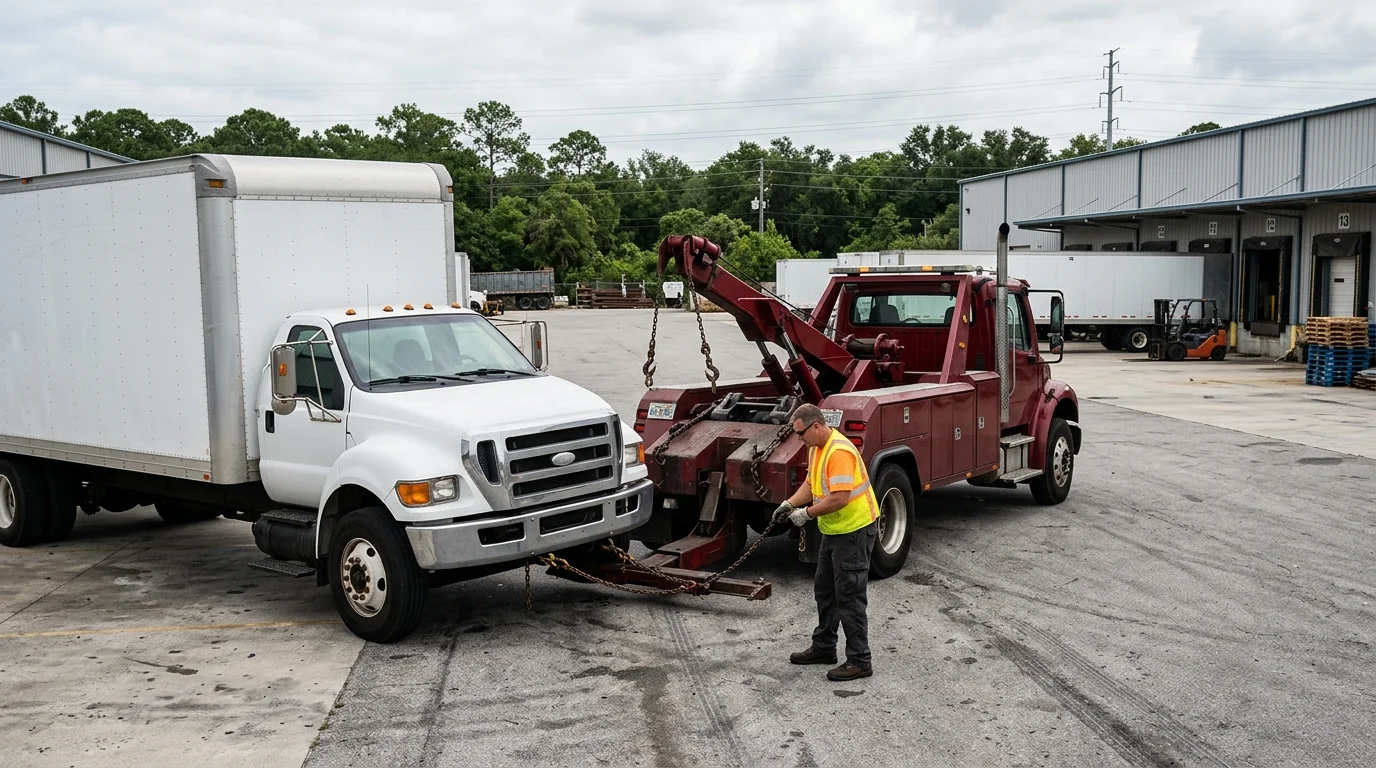
A loaded box truck can’t be treated like a passenger-car tow. For heavy duty towing for box truck breakdowns, cargo condition, wheel damage, clearance, road position, and destination all affect the plan. Sharing those details early helps us match you with an independent operator suited to the call.
Why the cargo changes the towing call
Cargo changes more than the truck’s total weight. Its location inside the box can also affect balance, recovery access, and how the truck sits. A full truck, a partial load, and an empty truck may need different plans.
That distinction matters during Orlando delivery runs. Picture a truck disabled near Tradeport Drive, Boggy Creek Road, or a warehouse entrance near Orlando International Airport. The same truck could be carrying secured pallets, loose furniture, appliances, or rolling carts. The outside shape alone doesn’t reveal what the operator will face.
Don’t describe the vehicle only as “a box truck.” Tell us whether it’s loaded, partly loaded, or empty. Describe the cargo and how it was secured. Mention any movement, leaning, broken restraints, or sounds from inside. If you have shipping paperwork, keep it available.
The operator also needs the truck’s actual vehicle information. Read weight details from the vehicle label, registration, or fleet records when available. Don’t guess from the box length or the number of axles. Those visual clues don’t replace the truck’s documented information.
A suitable heavy-duty towing operator will assess the truck, cargo, damage, and recovery position together. The operator may need to determine whether the load can remain in place. A shifted or unstable load may need attention before towing begins.
That assessment protects the cargo plan as well as the vehicle plan. It also reduces the chance that an operator reaches the scene without the equipment the job requires.
What the dispatcher needs before sending equipment
A box truck towing service needs a clear picture before equipment is assigned. When you call Quick Tow Orlando, we’ll collect the details and connect you with an independent operator.
Start with the exact location. Give the road name, travel direction, nearest entrance, or loading area. A pin can help, but it shouldn’t replace a plain description. Tell us whether the truck is in a traffic lane, parking lot, loading dock, shoulder, median, ditch, or gated property.
Next, identify the truck as precisely as possible. Share its make, model, year, cab style, and box size when known. Read the vehicle’s documented weight information exactly. Also mention attached equipment, a liftgate, trailer, or anything extending beyond the normal body.
Describe the failure and current condition:
- Is the engine running?
- Can the transmission shift?
- Does the steering respond?
- Do all wheels roll?
- Is any tire flat, missing, or trapped?
- Is there visible wheel, suspension, axle, or body damage?
- Is the truck upright, leaning, or resting against something?
- Are fluids visible on the pavement?
Then describe the cargo. The dispatcher should know whether it’s secured, loose, fragile, refrigerated, leaking, or visibly shifted. If labels or shipping documents identify hazardous material, say so immediately. Don’t touch an unknown leak or enter an unstable cargo box.
Photos can fill important gaps when they’re safe to take. Useful views include the full truck, damaged wheels, the roadway, the cargo-box angle, and the available approach space. Never enter traffic or stand near an unstable vehicle for a better picture.
Commercial truck breakdown towing depends on accurate details. A short, specific report gives the operator more useful information than a confident guess.
How clearance and road position affect recovery
A box truck can be upright and still sit in a difficult position. The operator needs room to approach, align equipment, manage the truck, and leave the property. Overhead clearance, gate width, loading docks, parked vehicles, curbs, soft ground, and tight turns can all shape the recovery plan.
Orlando presents several different settings. A truck beside SR 417 needs a different approach than one inside a warehouse yard. A breakdown near I-4 or SR 408 may leave little separation from moving traffic. A disabled delivery truck near International Drive could be surrounded by buses, loading zones, landscaping, and narrow service entrances.
Give the dispatcher a clear description of those limits. Mention low canopies, covered docks, garage entrances, security gates, steep ramps, or blocked exits. If the truck is inside a fenced property, confirm how the operator can enter. Don’t assume the recovery vehicle can follow the same path the box truck used.
Road position matters just as much. Say which wheels remain on pavement. Report whether the truck crossed a curb, entered soft ground, struck a barrier, or stopped at an angle. If the scene involves a collision, the work may require accident recovery and winch-out support rather than a basic tow.
Stay away from active lanes while you make the call. If you’re near a major road, FL511 traffic and incident alerts can help you review current conditions. Follow directions from law enforcement or road personnel at the scene.
For more detail on damaged-vehicle planning, read our guide to accident recovery towing in Orlando.
What happens when the load has shifted
A shifted load turns a vehicle problem into a cargo problem. The truck may lean, sit lower on one side, or place pressure against a rear or side door. You may also hear cargo moving when the vehicle rocks.
Don’t open the cargo doors to check. Items pressing against a door can move without warning. Don’t climb into the box, cut restraints, or try to straighten the load beside traffic. Those steps should wait for people who can inspect the truck and cargo conditions directly.
Tell the dispatcher what happened before the truck stopped. Sudden braking, a collision, a curb strike, or movement on a slope may help explain the condition. Report what you can see without diagnosing it. “The right rear corner sits lower” is more useful than declaring that the axle broke.
The operator will inspect the truck’s position and determine whether towing can begin with the cargo in place. Some situations may require cargo to be secured, removed, or transferred first. That decision depends on the actual truck, load, damage, and surroundings.
Keep fleet managers, the shipper, and the cargo recipient informed. They may need to arrange access, cargo handling, or another vehicle. If the load includes controlled, fragile, or temperature-sensitive goods, share the relevant paperwork and handling instructions.
Loaded truck towing works best when nobody hides a cargo problem. A shifted load discovered after equipment arrives can change the entire recovery plan. Clear reporting lets Quick Tow Orlando match the call with better context from the start.
Choose the repair or delivery destination first
Choose a destination before the operator begins moving the truck. A box truck shouldn’t be sent to a shop merely because it’s nearby. The receiving location needs to accept that truck and the type of damage involved.
Call the repair facility first. Describe the truck, its size, the apparent problem, and its loaded condition. Confirm where the operator should enter and where the vehicle can be left. Ask about gate access, overhead limits, unloading space, and procedures when the main entrance is closed.
The cargo may need a separate destination. A fleet manager might direct the truck to a secure yard, repair facility, warehouse, or transfer location. The shipper or customer may also need another vehicle to finish the delivery. Settle those instructions before movement begins when possible.
Distance also affects planning. A truck headed across Orlando presents different route and receiving questions than one leaving Central Florida. If the selected shop is outside the metro, review the practical factors behind a long-distance tow from Orlando. Confirm the final address directly with the receiving business.
Share the destination’s access conditions with the dispatcher. Mention narrow gates, covered service bays, crowded loading areas, or limited turning space. The operator needs to consider both ends of the trip, not only the breakdown scene.
Quick Tow Orlando can help match the call after you provide the truck, cargo, location, damage, and destination details. That information gives the independent operator a clearer job description before accepting the assignment.
When to call us
Call when a loaded box truck can’t move safely, has wheel damage, sits in a difficult position, or may have shifted cargo. Quick Tow Orlando will connect you with an independent towing or recovery operator serving the Orlando Metro. Call us at (321) 321-9797.